


R. Allen continued his activities in furthering the Space Interferometer Mission (SIM) and accepted an appointment to the new SIM Science Working Group. A postdoctoral fellow has been engaged to assist with simulations of the imaging performance of SIM in rotational synthesis mode. A paper on SIM was presented at a conference on future optical telescopes (Allen, Peterson, & Shao 1996).
Ray completed the construction of drive electronics for the experimental membrane mirror project Allen is carrying out with Shao (JPL), and the hardware was shipped to JPL. Testing of the prototype device using the ST ScI electronics is expected to take place later this fall.
A new release of the isophote STSDAS package considerably improved on both its user interface and its internal algorithms. A detailed Monte Carlo study enabled for the first time to include in the algorithms a consistent, meaningful computation of isophote parameter errors. Results of this study can be found in Busko (1996a).
The STSDAS package fitting was also improved, with explicit
computation of  , more sophisticated noise model and improved user
interface. A Monte Carlo study similar to the one done in isophote
enabled to quantify biases found in function coefficient determination, as
well as measure the accuracy of coefficient error bar computations. Results
are reported in Busko (1996b).
, more sophisticated noise model and improved user
interface. A Monte Carlo study similar to the one done in isophote
enabled to quantify biases found in function coefficient determination, as
well as measure the accuracy of coefficient error bar computations. Results
are reported in Busko (1996b).
A new set of STSDAS tasks for performing basic image processing with NICMOS images is undergoing development by Busko. These tasks provide the same basic functionality found in well-known existing tasks as IMARITH and IMSTAT, but with the added capability to access the extra pixel arrays contained in NICMOS ``images'' (errors, data quality, integration time). The tasks were developed in C language as part of the ongoing OpenIRAF project.
Instrumental work by C. Burrows has included the successful proposal of a coronagraph for the advanced camera (member of science team), optical verification by phase retrieval of NICMOS, and work on the science team with Lockheed for the NGST. Also a major effort to understand the HST wavefront and point spread function was published in Applied Optics, and is available to HST users through TinyTim.
J. Doggett, in collaboration with Lasker, Postman, and others, produced generic photometric calibrations for the three surveys used in the DSS--I (first Digitized Sky Survey). The overall accuracy is about 0.5 mag. The calibrations will be included in FITS extractions done by GetImage version 2.0 (for January 1997 release).
G. Greene, with McLean and Lasker, has developed a new object oriented database that are to be used both for evaluating the errors of GSC 1.2 (see below; also Morrison, et al., 1996) and for the initial production activities in GSC--II. This system is built on the Objectivity database management package. Important features of the new system include (1) ease of operation between catalog versions and with reference catalogs and overlapping plates, (2) speed and platform independence, and (3) extensibility to very large (Tbyte) catalogs. Thanks to liaison with R. Brunner (JHU), this work is being coordinated with similar developments in the SDSS archive. The possibility of sharing certain database features, e.g., the partitioning of the sky, with other large database developers is also under exploration.
R. J. Hanisch and J. Mo are collaborating with D. Redding and A. Boden (JPL) on work to model optical systems and their response functions and apply these models to image restoration. In the past year they have refined optical models for HST and developed a massively parallel computer implementation for image restoration with a spatially-variant point spread function. This code was used to aid in the interpretation of the jets in the Herbig-Haro object HH47 in collaboration with J. Morse (U. CO).
Hanisch, R. L. White, and R. J. Gilliland completed a review of image restoration techniques for HST. This review will appear as one chapter in the new edition of Deconvolution, edited by P. Jansson and being published by Academic Press.
B. Lasker (SOC Chair) and Postman (LOC Chair) organized IAU Symposium 179, New Horizons from Wide Field Imaging. The host institutions were ST ScI and JHU. A Book of Abstracts was also contributed by the University of Maryland. The main themes of the meeting were to bring together the various sky surveys (both existing and future) across the spectrum, to explore the relations between the surveys and the astrophysical opportunities, and to build strategies for working with the huge (multiple terabyte) databases associated with the surveys. The proceedings will be edited by McLean and published by Kluwer.
Lasker and his associates continued the digitization of the second generation
sky surveys, i.e., the AAO Second Epoch R Survey in the south
and all three passbands of the POSS--II in the north. The scans have
15  m sampling, and each plate is a 23050 square raster occupying
approximately 1.1 Gbytes. As of this writing, the scanning is over
half-completed. The scans are being compressed lightly (10X) and written to
six sets of CD ROMs, called the DSS--II (Digitized Sky
Survey--II). Highest priority is being given to an all-sky coverage in the
R-band; this is now about 40% complete.
m sampling, and each plate is a 23050 square raster occupying
approximately 1.1 Gbytes. As of this writing, the scanning is over
half-completed. The scans are being compressed lightly (10X) and written to
six sets of CD ROMs, called the DSS--II (Digitized Sky
Survey--II). Highest priority is being given to an all-sky coverage in the
R-band; this is now about 40% complete.
Lasker, in collaboration with Meakes, Doggett, and Postman, also completed a
CD set of heavily compressed (100X) images of the POSS--I (E) plates
for centers in 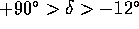 . (This is the same plate
material that was previously published with 10X compression in the 102-volume
DSS--I set.) This eight-volume set, which is being distributed as
RealSky by the ASP is supported by GetImage software (from
ST ScI) on UNIX and VMS systems and on PC and MAC systems by
RealSkyView (produced for ASP by Software Bisque). The constituency for
RealSky are the amateur and educational communities, and another
version directed to K--12 classroom use will be produced in 1997.
. (This is the same plate
material that was previously published with 10X compression in the 102-volume
DSS--I set.) This eight-volume set, which is being distributed as
RealSky by the ASP is supported by GetImage software (from
ST ScI) on UNIX and VMS systems and on PC and MAC systems by
RealSkyView (produced for ASP by Software Bisque). The constituency for
RealSky are the amateur and educational communities, and another
version directed to K--12 classroom use will be produced in 1997.
Lasker and Lattanzi (Torino), in collaboration with McLean, Hawkins, Greene, and White (ST ScI) and Spagna, Massone, Morbidelli, and Zacchei (Torino) are continuing with the development of a second Guide Star Catalog (GSC--II), which is to provide all-sky coverage to at least 18 mag with colors and proper motions. The input data are the scans of the DSS--I and --II, with calibrations from the GSPC--II and (when possible) from TYCHO. Details may be found in ESA SP 379, and production will begin early in 1997.
A collaborative effort by Morrison and Röser (Heidelberg), Bucciarelli (Torino), and Lasker and Mclean has produced a recalibration of the GSC--I. This catalog, GSC 1.2, is on the astrometric system of the PPM; and corrections for field-dependent errors and magnitude effects have been included. A preliminary release of GSC 1.2 has been made on the ST ScI WWW server; and a general distribution of the full catalog will be considered after a complete study of its errors has been completed.
M. Postman, Borgman (JHU student), Bucciarelli (Torino), Sturch, and Lasker continued work on the second Guide Star Photometric Catalog (GSPC--II), the goal of which is to provide a deep photometric sequence (V,R to 20 mag, also B whenever possible) for every Schmidt plate in the DSS--I and --II. At present, most fields in the north and over half in the south have at least one observation. An error analysis and a preliminary (FTP) data release are in preparation, and future efforts will be directed both towards in incomplete fields and towards increasing reliability by obtaining multiple observations as resources permit.
In 1995, H. Stockman and J. Mather (GSFC) were appointed study scientists for a feasibility study for a Next Generation Space Telescope (NGST), a large, passively cooled telescope to detect the earliest galactic structures at high redshift in the near infrared. As part of that study, they have organized a volunteer Science Working Group to define the science mission and capabilities for NGST. The initial portion of the study has recently been completed and an interim report will be issued in January 1997.