Summary
My research focuses on active galactic nuclei (AGN), supermassive black holes, and their host galaxies, with a particular emphasis on powerful radio sources, galaxy mergers, and gravitational‑wave recoil. I also lead an interdisciplinary project on joint cartilage and exercise countermeasures for long‑duration human spaceflight.
Below you can find three main themes of my work. Click on each title to expand and see more details, images, and links to selected papers and data sets.
Recoiling black holes, 3C 186, and HST‑3CR
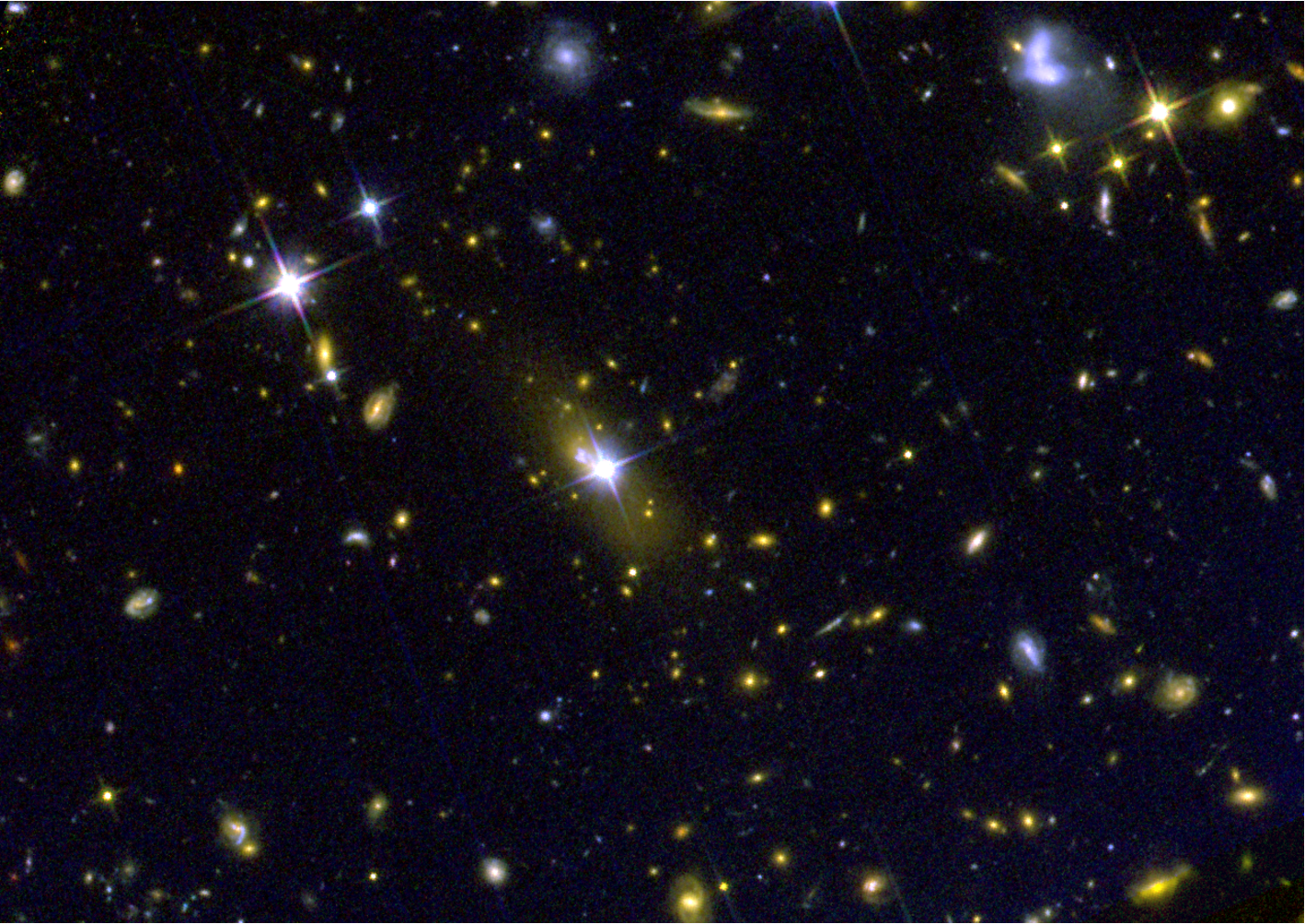
3C 186 and gravitational‑wave recoil
A key thread in my research is how galaxy mergers and black hole mergers affect AGN activity and galaxy evolution, including the possibility of gravitational‑wave recoil. In the radio‑loud quasar 3C 186, spatially offset emission and large velocity shifts in the broad‑line region are consistent with the presence of a recoiling supermassive black hole.
Recent multiwavelength work shows that both the accretion disk and the broad‑line region are blueshifted by a similar velocity relative to the host, which further supports the interpretation of 3C 186 as a recoiling supermassive black hole in a powerful quasar.
The HST‑3CR project and high‑z environments
I lead the HST‑3CR project, which uses the Hubble Space Telescope to obtain optical, IR, and UV imaging of 3CR radio sources across a broad range of redshifts. We have also used Chandra to observe the low‑redshift subsample in X‑rays, providing a homogeneous, high‑resolution view of powerful radio galaxies and quasars and their environments.
High‑level HST snapshot data for z > 1 3CR sources are publicly available, together with the rest of the sample from my HST program 16281, via MAST.
Selected papers and data
-
Chiaberge, M., Morishita, T., Boschini, M., et al. (2025),
"A recoiling supermassive black hole in a powerful quasar", arXiv:2501.18730.
[arXiv: 2501.18730 ] -
Chiaberge, M., Tremblay, G. R., Capetti, A., & Norman, C. (2018),
"The Recoiling Black Hole Candidate 3C 186", ApJ, 861, 56.
[ADS: 2018ApJ...861...56C ] -
Morishita, T., et al. (2022), "The Host Galaxy of the Recoiling Black Hole Candidate in 3C 186", ApJ, 931, 165.
[arXiv: 2204.12499 ] -
Breiding, P., Chiaberge, M., Lambrides, E., et al. (2024),
"Powerful Radio-loud Quasars Are Triggered by Galaxy Mergers in the Cosmic Bright Ages", ApJ, 963, 91.
[ADS: 2024ApJ...963...91B ] -
HST program 16281 data at MAST.
[MAST: HST program 16281 ]
AGN structure, jets, and high‑redshift work
AGN and radio galaxies
Much of my work focuses on the central regions of radio galaxies, quasars, Seyfert galaxies, and low‑luminosity AGN, primarily from an observational perspective. I use HST, Chandra, XMM‑Newton, and other facilities to study the structure of the nuclear emission, jets, and host galaxies.
I am particularly interested in the mechanisms that produce and sustain powerful radio jets, and in the long‑standing problem of the radio‑loud / radio‑quiet dichotomy, including detailed studies of nuclear dust, emission‑line regions, and compact jets in nearby AGN.
J1030 field and proto‑clusters
I am part of the J1030 field collaboration, which studies the environment of the z ≃ 6.3 quasar SDSS J1030+0524 and the associated large‑scale structure. The field hosts an overdensity of galaxies at the quasar redshift and a lower‑redshift (z ≃ 1.7) proto‑cluster centered on a powerful FR II radio galaxy.
I collaborate with the team on AGN and large‑scale structure science in this field, including work on the high‑redshift quasar environment, the z ≃ 2 proto‑cluster, and their connection to galaxy and black hole growth.
-
J1030 field collaboration website.
[Website: j1030-field.oas.inaf.it ] -
Morishita, T., et al. (2026), A&A, 706, A372.
[ADS: 2026A&A...706A.372M ]
JWST and little red dots (LRDs)
I also work on the nature of JWST "little red dots", compact red high‑redshift sources that may trace rapidly growing, heavily obscured supermassive black holes in the early universe. These objects are key to understanding how black holes grow and how they affect their host galaxies during the first billion years.
-
Lambrides, E., et al. (in press), "The Case for Super‑Eddington Accretion", arXiv:2409.13047.
[arXiv: 2409.13047 ]
MJ project and human spaceflight
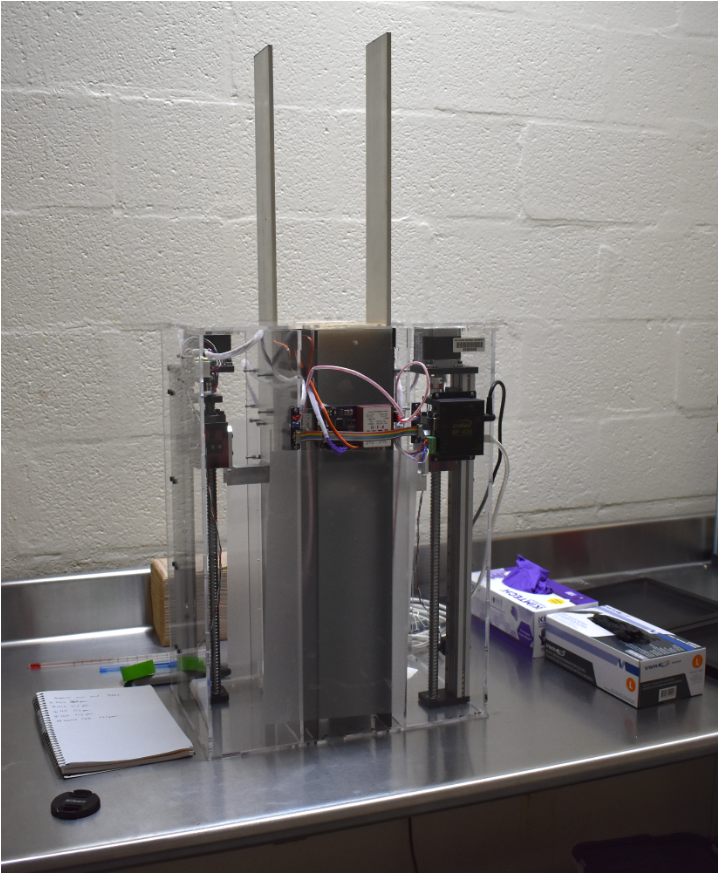
Beyond astrophysics, I lead the MJ ("mice jump!") project, a multidisciplinary collaboration between different departments at Johns Hopkins University with several external partners. We study how joint cartilage responds to microgravity and to specific exercise countermeasures, with the goal of enabling long‑duration human spaceflight.
Our recent work, now published in npj Microgravity, shows that plyometric "jump" training can increase knee cartilage thickness and volume in mice, supporting this mode of exercise as a promising countermeasure for long‑duration missions and the future use of cislunar space.
Selected publication
Chiaberge, M., et al. (2025), "Plyometric training increases thickness and volume of knee articular cartilage in mice",
npj Microgravity.
[Journal:
npj Microgravity article
]
Press coverage
- Johns Hopkins University press release: "Jumping workouts could help astronauts on the moon and Mars" .
- Carnegie Science press release: "Jumping mice could help astronauts avoid injury during long space missions" .
Current themes
- Recoiling supermassive black holes and off‑nuclear quasars (3C 186).
- High‑redshift radio galaxies and proto‑clusters (HST‑3CR, J1030 field).
- AGN structure, jets, and nuclear regions.
- JWST little red dots and obscured black hole growth.
- Exercise countermeasures and cartilage health in microgravity (MJ).
Publications
Full list of publications on NASA ADS:
ADS: Chiaberge, Marco (sorted by date)