 Non-polarimetry FOS observations should always be re-processed with the closeout AIS_CORR reference files and tables.
| 1
Pre-COSTAR GIM estimate refers to period before April 5, 1993.
|
To summarize the principal impacts for different types of observations are:
The FOS flux calibration was obtained from carefully centered (<=0.025" pointing accuracy in each coordinate) and flatfielded observations of spectrophotometric standard stars. Five standard stars, G191B2B, BD+28D4211, BD+33D2642, BD+74D325, and HZ44, were used for the pre-COSTAR calibration observations. For the post-COSTAR calibrations, this set and three additional white dwarf standards, GD71, GD153, and HZ43 were used. All pre-COSTAR observations were made with the 4.3 aperture and post-COSTAR observations were made with either the 4.3 or the 1.0 aperture. Typical formal S/N of binned spectral regions for these observations were 100 or often substantially greater.
Two methods of flux calibration have been used: FLX_CORR and AIS_CORR.
From early 1991 through mid-1992 the FOS experienced a systematic decline in sensitivity for all gratings and detector combinations. The systematic FOS/BL degradation in sensitivity by early 1992 amounted to approximately 10% for all gratings, and approximately 5% per year for FOS/RD (except for the G190H grating). The degradation in the FOS/RD G190H and G270H regions occurred at a rate of ~10% per year and was quite wavelength dependent.1 All pre-COSTAR degradation leveled off between mid-1992 and the end of 1993. In Figure 32.5 we show the time dependence of the pre-COSTAR sensitivity for FOS/BL G130H which was typical for that detector. Pre-COSTAR sensitivity changes for FOS/RD G400H, which were typical of most spectral regions for that detector, are shown in Figure 32.6 and for the FOS/RD G190H in Figure 32.9.
Post-COSTAR sensitivity shows a dip relative to the pre-COSTAR values between approximately 1500 and 2500 Å. Except for FOS/RD G190H and G160L post-COSTAR sensitivity has shown no believable systematic temporal variation (see Figures 32.7 through 32.11). From February, 1994 through July, 1994 FOS/RD G190H sensitivity dropped by approximately 2% and then increased from 3 to 15% between July, 1994 and September, 1996. These changes are contemporaneous with substantial flatfield changes in portions of this grating. FOS/RD G160L showed similar changes shortward of 2200 Å. Figures 32.8 and 32.10 show the time dependence of post-COSTAR FOS sensitivity for the FOS/RD G190H grating.
The thick lines in Figure 32.8 indicate the average time-dependent sensitivity correction applied by the TIM-CORR calibration step (as contained in the .cyc reference file).
Overall Flux Calibration Accuracy Summary
The overall accuracy of the FOS photometric calibration for well-centered sources in the larger apertures, following recalibration with the appropriate updated reference files, is currently estimated to be 3% (1  ) for all grating modes except for FOS/RD G160L, FOS/RD PRISM and G780H longward of 7500 Å; for those specific settings the accuracy is 4% (1 ). In addition, there may have been systematic changes in the sensitivities at the 2% level which were not accurately tracked in the calibrations over some periods of times (see Figures 32.7, 32.8, and 32.11).
The relative photometry within a given standard spectrum is estimated to show roughly ± 2% curvature about the mean over correlation lengths of approximately 250 Å (see for example the relative spectra in Figure 32.14 and Figure 32.15, which show limiting examples of this effect that occurred occasionally in standard star spectra). Excursions to ± 4% are seen in some extreme cases.
The principal factors which contribute to this overal calibration accuracy include the following.
 > 7500 Å), where repeatability is good to ~3%. See FOS ISR 144 for plots of accuracies for each mode as a function of wavelength.
Actual FOS observations could have more uncertainty than this global 3% limiting accuracy, especially if the pointing uncertainty exceeded 0.1-0.2" as it often did, particularly in the pre-COSTAR era.
For example, with the 0.3 (B-2) aperture a target miscentering of 0.12" (the centering accuracy routinely achieved with ACQ/BINARY acquisition mode) led to a flux loss of about 60% with respect to perfect centering. The expected flux loss for a pointing accuracy of 0.03" (typically reached with a high precision multi-stage peak-up sequence) led to flux losses of less than 4% in the 0.3 aperture. Observing with the 1.0 aperture, the same pointing accuracy of 0.03" led to no measurable flux losses. For this aperture, the pointing accuracy of the binary target acquisition technique was sufficient. It resulted in flux losses of less than 3%
 Determine your pointing accuracy from the FOS paper products for ACQ/PEAK
acquisitions or assume one values from Table 32.5 for ACQ/BINARY. Use
Figures 32.12 and 32.13 to estimate light loss for this degree of miscentering.
Determine your pointing accuracy from the FOS paper products for ACQ/PEAK
acquisitions or assume one values from Table 32.5 for ACQ/BINARY. Use
Figures 32.12 and 32.13 to estimate light loss for this degree of miscentering.
Here are a few points to remember:
=0.007") so that large aperture observations are not affected unless the target was poorly centered by the target acquisition. Smaller aperture observations can be affected. Typical random jitter produced <3% light loss for 0.3 pre-COSTAR and <1% post-COSTAR.
Examine the paper products jitter ball plot for anomalous tracking. Examine the paper products group counts plot to assess photometric repeatability between readouts.
The primary photometric effect of any x-component of FGW non-repeatability was to introduce some uncertainty as to the exact correspondence between the portion of the photocathode granularity sampled by an arbitrary observation and that sampled by STScI calibration observations. The net effect, for most gratings, was to introduce a small amount of random additional noise, typically on the order of <1%, into the flatfielded spectrum (See "Flatfield Calibration" on page 32-38.).
32.6.4 Image Centering (Image Location) Factors
Y-base and GIM effects
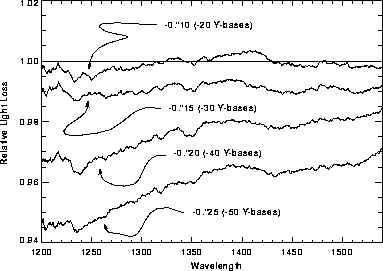
Absolute and relative (spectrum shape or color) accuracies are limited by Y-base uncertainties for the 1.0 and larger apertures. The size of the spectrum and the positioning of the spectrum s-curve on the diode array were the limiting factors. Smaller apertures were typically not affected as the scale of Y-base error (<25 Y-bases in most cases as seen in Figures 32.1 and 32.2) was much smaller than the distance between the edge of the aperture image on the photocathode and the height of the area on the photocathode that was readout. Y-base photometric effects could be substantial for the large apertures, especially for extended objects. The exact amount of light lost depended on the size of the error, but commonly 3-10% effects were seen pre-COSTAR and 1-10% effects post-COSTAR. Note the apparent effect of poor Y-bases in Figure 32.14 which shows the ratio of flux-calibrated standard star spectra to the reference energy distribution. Of particular interest is the 1200-1600 Å. region in the BD+28D4211 observations near 1994.4. The installed Y-bases for FOS/BL G130H deviated at that time by nearly 40 Y-base units from the nominal trend (see Figure 32.1). Clear 4-5% effects are seen in these precisely centered observations made with both 1.0 and 4.3 apertures (see Figure 32.17).
 Look for broad features similar to the residuals seen in Figures 32.14 and 32.15.
The shape of the features can be anticipated by considering the effect of shifting
the s-curves in Figures 32.3 and 32.4 toward the top and bottom of the diode array.
Reference to Figures 32.1 and 32.2 provides an idea of how close the installed
Y-bases were to the continuing trend. Remember that the typical scale of Y-base
uncertainty was up to 25 Y-bases, which could be exacerbated by similar amounts
of FGW positioning offsets.
Look for broad features similar to the residuals seen in Figures 32.14 and 32.15.
The shape of the features can be anticipated by considering the effect of shifting
the s-curves in Figures 32.3 and 32.4 toward the top and bottom of the diode array.
Reference to Figures 32.1 and 32.2 provides an idea of how close the installed
Y-bases were to the continuing trend. Remember that the typical scale of Y-base
uncertainty was up to 25 Y-bases, which could be exacerbated by similar amounts
of FGW positioning offsets.
32.6.5 Telescope Factors
OTA Focus
As noted in "Telescope Focus Changes" on page 32-16 the focus of the telescope had a pronounced effect on FOS throughput in the pre-COSTAR period. The AIS_CORR flux calibration completely corrects the wavelength-dependent throughput of each aperture for this effect.
Breathing
Thermal breathing introduced an aperture-dependent variation in throughput as a function of orbital position. Naturally, the effect was worse for the smaller apertures. For the pre-COSTAR period a 4-7% light loss occurred; in the post-COSTAR period the effect was more typically 1-3%.
 Examine the paper products group plot for any series of readouts lasting more
than 1000 seconds. Figure 32.16 shows an example of an approximate 3% thermal
breathing effect for a precisely centered, low jitter (peak-to-peak excursions =
0.01") photometric target observed through the 0.3 aperture in a RAPID mode
time-series of nearly eighty 30-second integrations all in one visibility.
Examine the paper products group plot for any series of readouts lasting more
than 1000 seconds. Figure 32.16 shows an example of an approximate 3% thermal
breathing effect for a precisely centered, low jitter (peak-to-peak excursions =
0.01") photometric target observed through the 0.3 aperture in a RAPID mode
time-series of nearly eighty 30-second integrations all in one visibility.
Figure 32.5: Pre-COSTAR Typical Sensitivity Time Dependence: FOS/BL
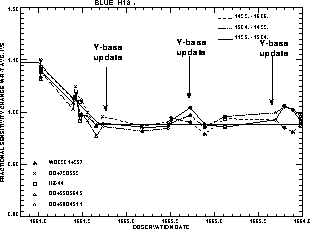
Figure 32.6: Pre-COSTAR Typical Sensitivity Time -Dependence: FOS/RD
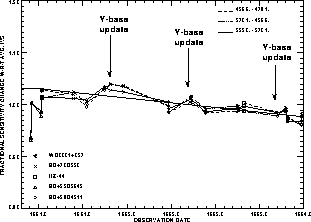
Figure 32.7: Post-COSTAR Sensitivity Time Dependence: FOS/BL
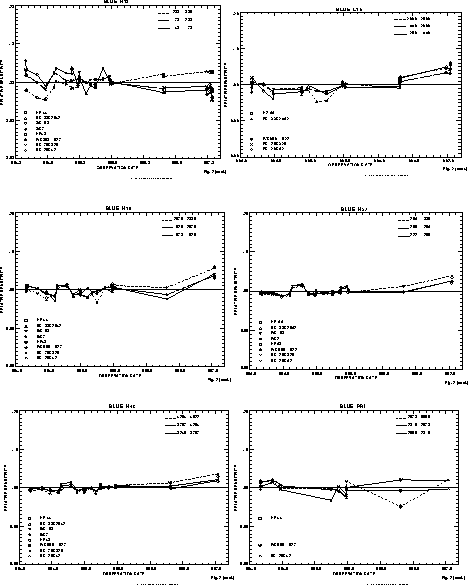
Figure 32.8: Post-COSTAR Sensitivity Time Dependence: FOS/RD G190H
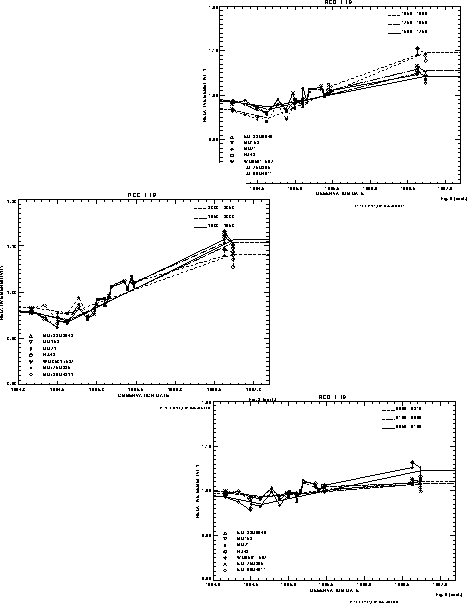
Figure 32.9: Pre-COSTAR Time -Dependence in FOS/RD G190H Grating
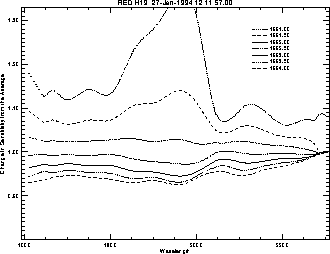
Figure 32.10: Corrections as a Function of Wavelength for FOS/RD G190H
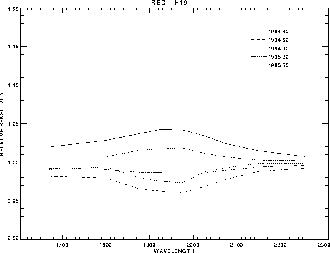
Figure 32.11: Post-COSTAR Sensitivity Time Dependence: FOS/RD
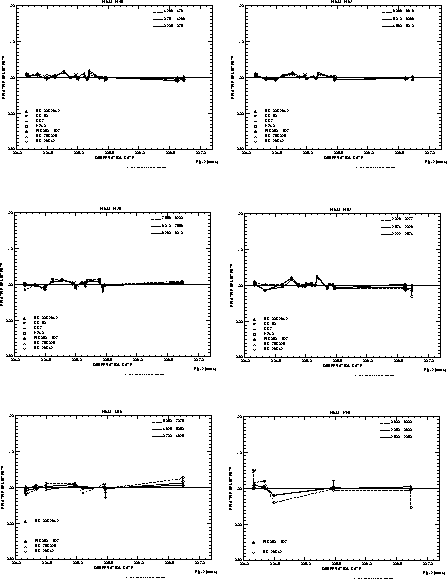
Figure 32.12: Post-COSTAR Transmitted Flux Versus Pointing Error: FOS/RD
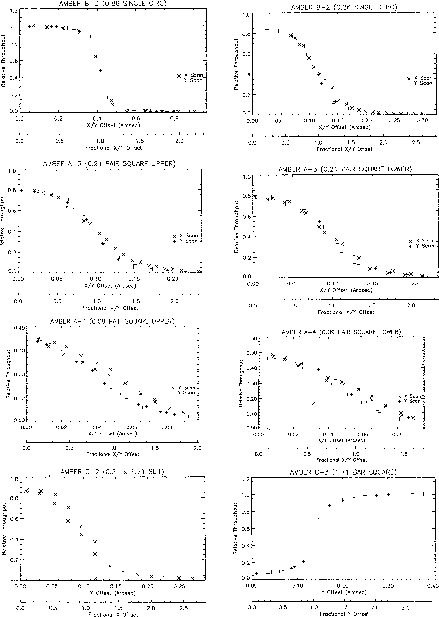
Figure 32.13: Post-COSTAR Transmitted Flux Versus Pointing Error: FOS/BL
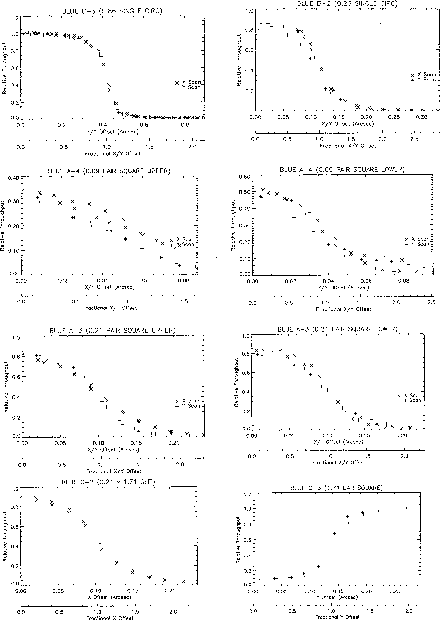
Figure 32.14: FOS Standard Stars Compared with Models: FOS/BL
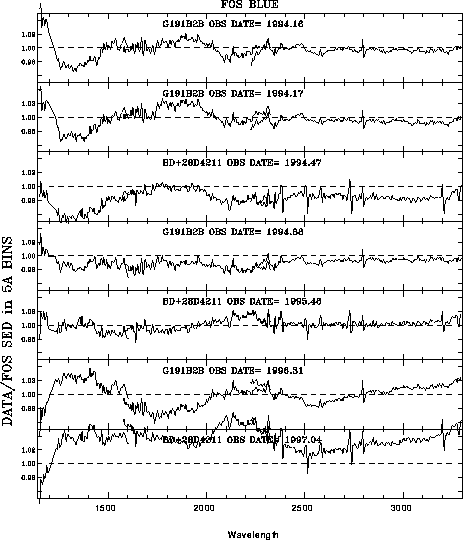
Figure 32.15: FOS Standard Stars Compared with Models: FOS/RD
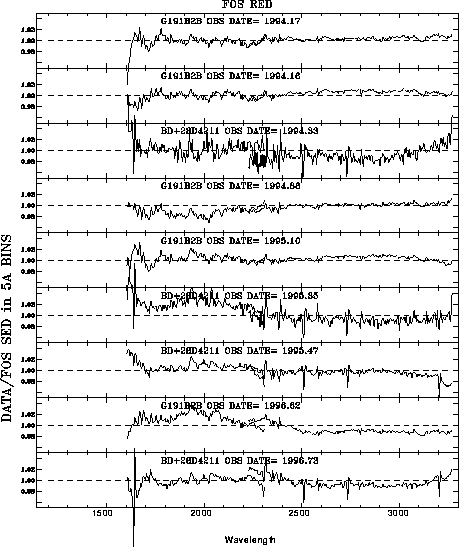
Figure 32.16: Example of Breathing Effect on Well-Centered 0.3 Observation
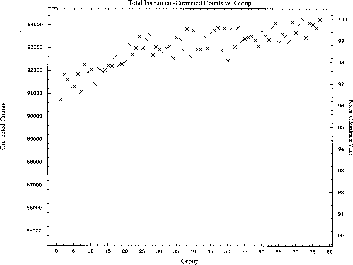
Figure 32.17: Relative Light Loss Due to Mis-centering or Y-base Error (FOS/BL G130H)
Target Acquisition
Aperture
Pattern
Name
Search-
size-X
Search-
size-Y
Step-size-X
(arcsec)
Step-size-Y
(arcsec)
Pointing Accuracy (arcsec)
4.3
A
1
3
-
1.23
-
1.0
B1
6
2
0.61
0.61
0.43
0.5
C1
3
3
0.29
0.29
0.21
0.3
D1
5
5
0.17
0.17
0.12
D2
5
5
0.11
0.11
0.08
D3
5
5
0.052
0.052
0.04
E1
4
4
0.17
0.17
0.12
E2
4
4
0.11
0.11
0.08
E3
4
4
0.052
0.052
0.04
F1
3
3
0.17
0.17
0.12
F2
3
3
0.11
0.11
0.08
1.0-PAIR
B2
6
2
0.61
0.61
0.43
0.5-PAIR
C2
3
3
0.29
0.29
0.21
0.25-PAIR
P1
5
5
0.17
0.17
0.12
P2
5
5
0.11
0.11
0.08
P3
5
5
0.052
0.052
0.04
P4
4
4
0.11
0.11
0.08
2.0-BAR
BD1
1
11
-
0.052
0.03
0.7-BAR
BD2
1
11
-
0.052
0.03
SLIT
S
9
1
0.057
-
0.03
ACQ/BINARY
Z
-
-
-
-
0.12 )
ACQ/BINARY
Z
-
-
-
-
0.08 )
Pattern Pointing Accuracies
32.6.6 Extended Source Aperture Dilution Correction
 The calfos flux calibration of all extended sources is always incorrect! You should
always apply the aperture dilution corrections found in this section.
The calfos flux calibration of all extended sources is always incorrect! You should
always apply the aperture dilution corrections found in this section.
Flux calibrations are determined from observations of standard stars and compensate automatically only for any light in the PSF that falls outside the aperture. For observations of extended sources, a correction needs to be applied to the final flux calibrated spectrum to correct for the non-pointlike illumination pattern. The correction is given by: 
 = Solid angle of the aperture or object, whichever is smaller, in square arcseconds, e.g., 4.3" x 1.43" (pre-COSTAR) and 3.66" x 1.29" (post-COSTAR) for the 4.3 aperture.
The deployment of COSTAR produced a narrower PSF, which led to considerably higher aperture throughputs. For the large apertures (1.0 and larger) post-COSTAR there is no measurable difference in aperture throughput between FOS/RD and FOS/BL. Therefore, we list both detectors separately only for the 0.3 aperture and the slit in Table 32.7. Throughputs do change as a function of wavelength (or grating). Therefore, we list ratios for the different dispersers separately. The numbers are from FOS ISR 136.
Grating |
BLUE |
RED |
UNC1 |
BLUE |
RED |
UNC |
BLUE |
RED |
UNC |
BLUE |
RED |
UNC |
|---|---|---|---|---|---|---|---|---|---|---|---|---|
Mode |
B-3 (1") |
B-1 (0.5") |
B-2 (0.3") |
C2-SLIT | ||||||||
|
HIGH
|
0.58
|
0.60
|
.02
|
0.41
|
0.44
|
.02
|
0.27
|
0.31
|
.03
|
0.39
|
0.41
|
.02
|
|
LOW
|
0.65
|
0.67
|
.06
|
0.46
|
0.50
|
.04
|
0.31
|
0.35
|
.03
|
0.43
|
0.45
|
.03
|
|
PRISM
|
0.53
|
0.54
|
.06
|
0.37
|
0.39
|
.04
|
0.26
|
0.30
|
.03
|
0.37
|
0.39
|
.03
|
| 1
The uncertainties (UNC) do not include the possible contributions of pointing errors, OTA breathing, -jitter, or Y-base errors in an arbitrary science observation.
|
32.6.7 Absolute Photometric Calibration System Offsets
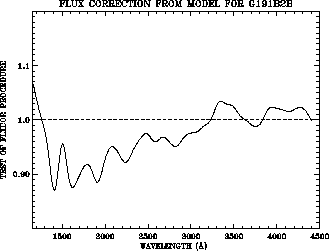
Many FOS observations in the HST Archive and in the literature have been flux-calibrated on the now obsolete absolute photometric system of Bohlin et al. (1990). All re-calibrated FOS observations have been calibrated with the AIS_CORR system which produces fluxes on the white dwarf flux scale, based upon eight standard stars3. The older system differs from the AIS_CORR scale by <15% for wavelengths < 2000 Å, ~5% for the wavelength range 2000-3500 Å and <3% for wavelengths > 3500 Å (see Table 32.8). An illustrative comparison of the previous flux scale and the white dwarf flux system is shown in Figure 32.18.
FLX_CORR and AIS_CORR Calibration System Differences
Wavelength
% Uncertainty
Far UV
~10%
Near UV
~5%
Visible
~3%
Figure 32.18: FLX_CORR to AIS White Dwarf Flux System Ratio
32.6.8 Overlap Region of Adjoining Gratings
Often fluxes do not agree well in the wavelength overlap regions of two FOS dispersers. Koratkar and Evans (1998, Ap.J. submitted) surveyed a total of 151 FOS pre-COSTAR observations of AGN, which are typically much fainter objects acquired with substantially less accuracy than FOS calibration sources. They found 5% agreement as typical in the overlaps between G130H, G190H, and G270H. FOS spectrophotometric standard stars typically show much better agreement in these regions, but inspection of Figures 32.14 and 32.15 shows that 2-5% variations were occasionally seen for these objects, as well. The effect of the spectrum s-curvature in the overlap regions combined with the influences of relatively poor centering (common for the AGN) and/or Y-base and FGW uncertainties to reduce the amount of light recorded by the diode array at the edges of these regions. Note that a 5% error in the 100 or so pixels at the edges of the spectrum does not imply a similar level of error at the center of the observed spectral region.
2 See FOS ISRs 106 and 107.
3 FOS ISR 144.
stevens@stsci.edu Copyright © 1997, Association of Universities for Research in Astronomy. All rights reserved. Last updated: 01/14/98 14:55:10