


Near the exit pupil, in the F/96 relay are located four independently commandable rotating filter wheels. Two such wheels are located at or near the exit pupil in the F/48 relay. The filter wheels for the F/96 relay each have 12 equidistant working positions while for the F/48 relay each wheel has 8 equidistant positions. Each wheel has one clear position. These devices carry a full complement of wide, medium and narrow bandpass and neutral density filters, polarizing and objective prisms.
Absolute image position on the FOC focal plane can be referred to a grid of 17 17 reseau marks, each 75 75 microns squared in size evaporated on the inner surface of the photocathode MgF2 window. The overall wavefront distortion of the FOC+COSTAR optical system is less than l/10 for the F/48 relay and the F/96 relay at l6328Å.
In the F/48 relay, the beam from the folding mirror may be relayed by a removable toroidal convex mirror to a fixed spherical concave reflection grating which re-images a spectrum of a portion of the field of view onto the detector photocathode. This portion contains a fixed width rectangular slit that is located on the entrance aperture (see Figure
Figure 4.1: Transfer Optics Block Diagram. (Dashed frames are removable components).
Once past the shutter, radiation impinges on a two element aplanatic optical system consisting of a spherical concave primary and an elliptical convex secondary mirror. This optical system magnifies the OTA focal plane by a factor of two for the F/48 relay and four for the F/96 relay with negligible spherical aberration or coma. The mirrors are all made of Zerodur and overcoated with Al + MgF2 for a reflection efficiency exceeding 0.7 above 1200Å.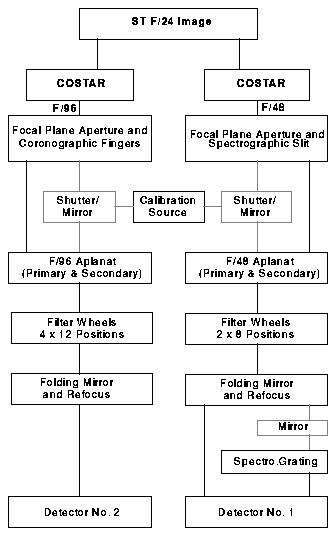
Figure 4.2: Schematic Optical Layout of the Two Cameras in the Planes Containing the V1 Axis and the Chief Rays.
In order to fold the light beam back onto the detector and to focus the FOC, a cylindrical concave mirror is placed into the slowly converging beam past the filter wheels. This mirror also corrects for the residual off-axis OTA astigmatism and is made of the same materials as the primary and secondary mirrors. This mirror is mounted on a commandable focusing mechanism that allows it to internally compensate for variations in optical path length introduced by the OTA focus variations, FOC internal stability and by the differing optical thicknesses of the various optical elements on the filter wheels. The focusing mechanism changes the length of the optical path by xb1 16 millimeters maintaining the position of the image on the detector typically within 0.05 millimeters whatever the location of the mirror along the stroke. The FOC focal plane is designed to coincide with the detector photocathode plane. The detector samples an area of 24.6 24.6 millimeter squared corresponding to 1024 1024 pixels, each @ 24 micron squared in size, averaged over the field of view.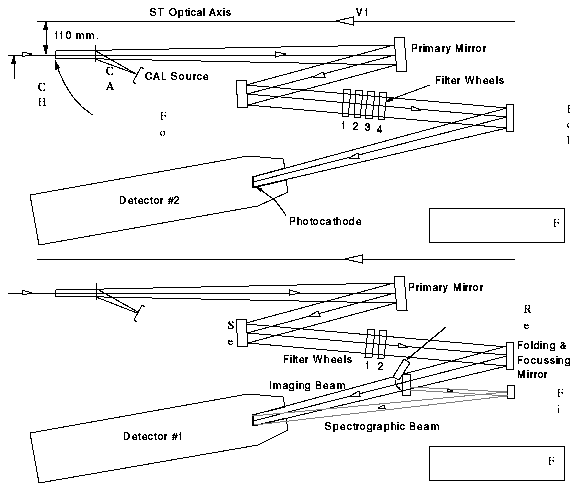
Generated with CERN WebMaker