


Figure 6.1: Radial Profiles of Pre-COSTAR Aberrated PSF (dotted line) and COSTAR-Corrected PSF (solid line) at 4860Å.
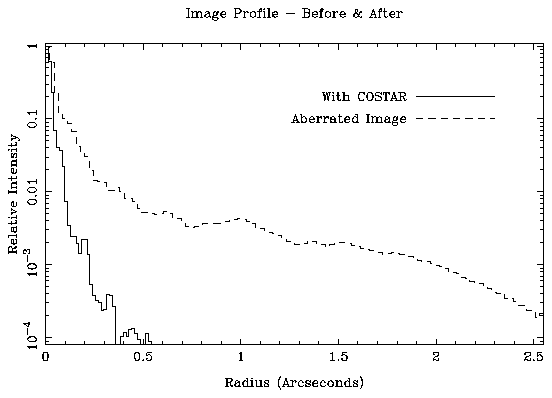
Table 6.1: Measured Energy Fraction e(l) for the F/96 Relay
In Table 6.1, the encircled energy fraction e(l) is tabulated for various circular apertures against the number of pixels in the aperture and the effective radius (defined as 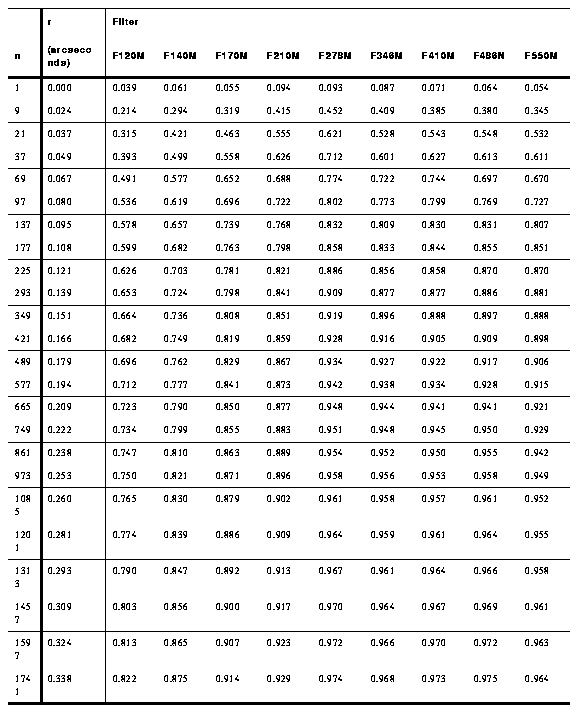
 , with the definition that the encircled energy is 1.0 at a radius of 1 arcsecond (70 pixels)). A more thorough discussion of the definition of the encircled energy calculation and the rationale behind it is given in "Absolute Quantum Efficiency" on page 70. These energy fractions are to be used to predict how many counts one can expect to measure given the total count rate from FOCSIM or SYNPHOT, or from using the formulation in Chapter 7. For the most part, these numbers are believed to be good to approximately 10% or so, but they are subject to variation due to the changes in the effective focus of the OTA ("breathing"). This typically causes the fraction of the energy in small apertures (with radius 3 pixels or so) to vary by ~10%, but with worst case variations of up to 50%, and is most severe in the 2000-4000 Å range. Taking PSF observations just before or after one's science data will not help to improve the measurement of encircled energy, since the variation is orbital in nature.
The improvement in performance over the aberrated PSF is shown in Figure 6.2, where the encircled energy curve is compared to that of the aberrated OTA and with a perfect diffraction-limited image from a 2.4m circular aperture with a 0.33 central obstruction. It can be seen that the COSTAR-corrected FOC PSF approaches that of an ideal imaging system in both encircled energy performance and in the FWHM of the PSF core.
Figure 6.2: Encircled Energy Fraction and PSF Profile for the COSTAR-Corrected F/96 and Pre-COSTAR F/96 Relays Compared to Those Expected from a Perfect Diffraction Limited OTA.
The profile of the PSF itself is not characterized to very high accuracy, since this would require long integrations at many different wavelengths. The signal-to-noise ratio of PSF images taken for the DQE measurement program typically allows measurement of the PSF profile to 25-50% accuracy when azimuthally averaged over a 1-pixel wide annulus. Variations of the profile will occur in the core as a result of OTA orbital variations, but outside 0.15 arcsec radius the PSF profile is dominated by scattering from small-scale irregularities in the OTA & COSTAR mirrors and FOC optics. It is recommended that if observers need accurate characterization of the PSF for their data (for example, if they are trying to detect low-surface brightness features in the vicinity of bright point-like sources), then they should explicitly ask for such calibration time in their proposal. Again, it is stressed that characterization of the PSF interior to 0.1 arcsec is not possible, because of its dependence on orbital variations in the focus.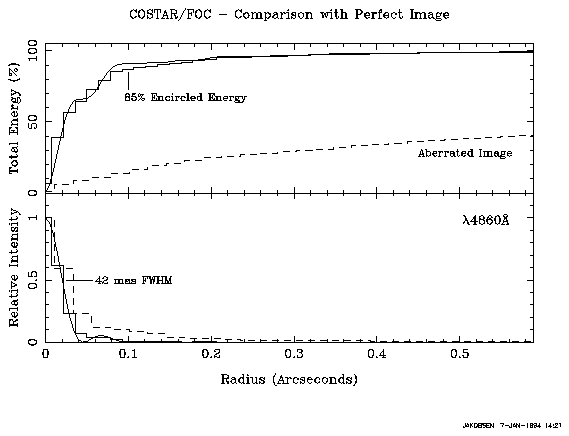
Figure 6.3: Variation of FWHM with Wavelength for the F/96 Relay.
The resolution provided by the HST+FOC combination is characterized in a simplistic way by specification of the FWHM of the PSF as a function of wavelength. This was measured for a sample of PSF observations using the raw (.d0h) images, so that there would be no degradation by the geometrical correction resampling process. The FWHM was measured in both the X and Y directions by simply interpolating where in the 1-dimensional profiles the intensity dropped to half of the peak value; no attempt was made to account for undersampling. The mean of X and Y FWHM is plotted as a function of wavelength in Figure 6.3
Despite the outstanding performance of the OTA+COSTAR+FOC imaging system in terms of encircled energy within small radii, the PSF appearance does not quite match a true diffraction-limited simulation perfectly at all wavelengths. The PSF obtained using the F486N filter shows a non-uniform azimuthal intensity distribution in the first diffraction ring (Figure 6.4a). There is also a small amount of residual coma that possibly varies with time, possibly due to some slack in the M1 tilt mechanism. This was removed for the most part by a small tilt of the COSTAR M1 mirror in early August 1995.
In the ultraviolet, the PSF shows a fairly strong jet-like feature pointing approximately in the -V3 direction (Figure 6.4b). The strength decreases with increasing wavelength but is still quite noticeable at 4000Å. The cause of this feature and the asymmetry in the first diffraction ring is unknown.
Several filters have been found to have artifacts. The F372M filter shows a strong linear feature in the PSF wings, at approximately 45xfb to the OTA spider (Figure 6.4c). The F501N and F502M filters both show a faint ghost image 60 and 24 pixels respectively from the PSF center, approximately 5 magnitudes fainter than the core. The PSF taken through the F320W filter is significantly degraded, having a FWHM of approximately 6x2.5 pixels (compared to 2.5x2.5 pixels for the F342W PSF, see also Figure 6.3). This causes the central pixel to contain only 3.5% of the total light in the PSF, compared to 10% for the F342W filter.
A selection of PSF images is available on STEIS. The PSF images, and other FOC information on STEIS, is accessible via anonymous FTP, gopher, or WWW's Mosaic interface at stsci.edu (see Chapter 9 for more details).
The field-dependence of the PSF was investigated during SMOV, but the limited observations do not allow detailed characterization of the performance as a function of field position. It is clear from calibration observations that the PSF is visibly different away from the central field point across the largest formats. However, this does not affect the encircled energy within 0.1 arcsec radius by more than a few percent for any field position within the 512 x 512 aperture. A more thorough evaluation of the field dependence of the PSF will follow in a future Instrument Science Report.
Figure 6.4: Images of PSFs Taken with the COSTAR-Corrected F/96 Camera
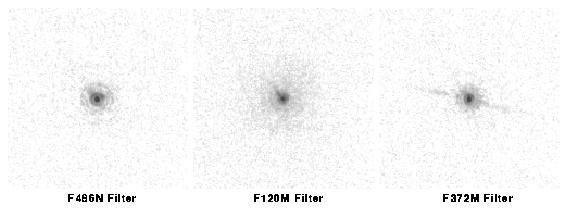
Image quality and Field Dependence of the PSF
The FOC was designed to image the HST focal plane in an off-axis position, 6.56 arcminutes from the optical axis. At this distance, the focal plane is tilted with respect to the V1 axis by 10xfb . It is this plane that the FOC cameras image onto their photocathodes. However, the focal surface produced by COSTAR is tilted with respect to the plane that the FOC images. This results in a field-dependent focus variation of approximately 0.7mm over the full field of the F/96 relay. Similarly, the tangential and sagittal focal surfaces are tilted with respect to each other, and this introduces field-dependent astigmatism. Both of these effects increase linearly with distance from the fully-corrected field point.
Generated with CERN WebMaker