


Figure 6.8: Stray Light Illumination in V Magnitudes Arcseconds-2 at the OTA Focal Plane Due to the Moon and Daylit Earth as a Function of Off-axis Angle Determined from In-orbit Observations. Limits on zodiacal light contribution are also given.
The average zodiacal light background of 120 S10 corresponding to V @ 23 magnitudes arcsec-2 is reached at angles greater than 80xfb to the limb, approximately. For viewing configurations in which the angle is less than this value, stray light will dominate in most situations. One of the most interesting of these is that encountered when observing in the continuous viewing zones (CVZ) which, in principle, allows for long uninterrupted integrations of very faint sources. Due to the altitude of the spacecraft and the depression of the horizon, the off-axis angle to the Earth limb in the CVZ will be in the range 20xfb - 44xfb , approximately. From Figure 6.8, the expected stray light illumination in this configuration in the visible will be between 20th and 23rd magnitudes arcsec-2. This means that observations in the visible will be limited mainly by this source of background. Below 3400Å, however, this effect will be negligible, as shown in Figure 6.9, providing an opportunity to use the CVZ for the detection of faint sources with the minimum level of background light.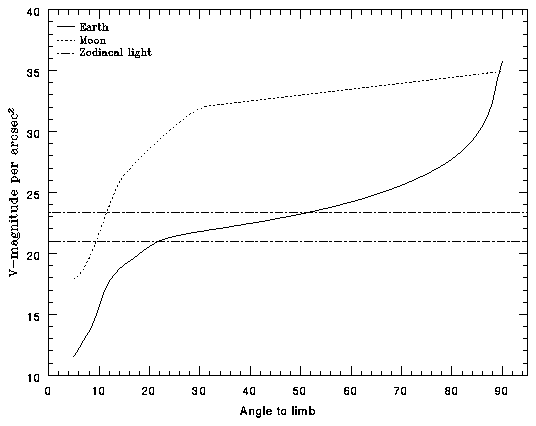
Figure 6.9: The Earth's Daylight Radiance in Rayleighs Å-1 i.e. 106 /4p photonscm-2 sec-1 Å-1 sr-1 as a Function of Wavelength Averaged Over One Orbit given for Different Earth Limb Angles. The sun is assumed to be at the zenith providing the most stray light.
It is of more than passing interest to the observers to pay some attention to the maximum allowable background they can tolerate for their specific observation. The most heavily affected observations are those of faint extended sources, where the background can have comparable count rates. For example, a spiral galaxy with B=20.5 magnitudes arcsec-2 could be observed with the F430W filter and achieve a S/N of 10 over a 0.1"x0.1" region in 57 minutes under average observing conditions. Generally this would require a CVZ observation since most orbit viewing periods are only about 50 minutes long (on average). However, in the CVZ, the stray light can be as bright as V=21 magnitudes arcsecond-2, which would require a 83 minute exposure to obtain the same S/N. This situation can be remedied by specifying the Special Requirement "SHADOW" to force the observations to be taken only during Earth shadow or "LOW SKY" to force the observation to be taken only when the background can stay within 30% of the minimum obtainable levels. For the CVZ observations, this would constrain the observations to be scheduled for orientations of low stray light insuring the best possible S/N and while using the entire CVZ. This requirement should be considered for all observations requiring low background levels, especially background from stray light, and included in the Phase II proposal if deemed necessary. These considerations can dramatically improve the detection of faint targets through the best use of the CVZ. 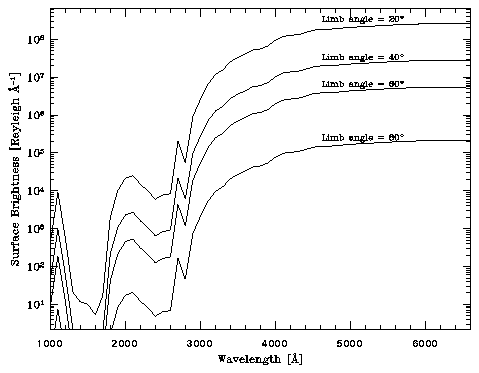
Generated with CERN WebMaker