


For a point source in the FOC field of view and for a count rate per pixel much less than NMAX calculated from Table 6.2, the source rate is given by:
where:
The ratio of obscured area to total area of the primary mirror, equal to 0.138, has been integrated into the values of Q(l) for consistency with SYNPHOT. The terms in eq. (2) can be assumed to be appropriate averages over the pixel to pixel variations in the instrument response function. Q(l) and T(l) are plotted in Figures 6.7 and 4.7 through 4.11.
The background rate, on the other hand, can be expressed, in general, as:
where:
Equations (2) and (3) can be evaluated numerically or by approximating them by assuming that the spectral passband is sufficiently narrow. This permits the following simplifications:
where all the relevant functions are evaluated at wavelength l0 of peak response and Dl is the FWHM bandpass of the instrument in Angstroms. The latter two parameters are listed in Table 3
For an extended source, the size of the resolution element nz is determined by the user according to his application. For a point source, the encircled energy tabulated in Table 8 should be used to determine e(l) and nz for each specific case. The precise area to be used depends in general on the S/N ratio. If it is very high, one can afford to increase the size of the resolution element nz to collect more photons, if it is low, nz should be kept as small as possible. For any particular situation, there is an optimum nz at which the S/N is maximum for a given exposure time t or at which t is minimum for a given S/N ratio. A few quick calculations should be enough to locate this condition once the background has been properly defined as indicated in the next paragraphs.
Figure 7.1: Residual 1216 and 1304Å Airglow Contribution to the FOC Background Counting Rate with No Filters in Place in Counts sec-1 Per Normal Pixel as a Function of the Solar Zenith Angle at the Spacecraft at 500km Altitude. The line of sight is assumed to be oriented towards the zenith.
At least two sources of diffuse background have to be considered in estimating IB(l0) in eq. (5). The first is residual airglow above the ST altitude of 500-600 km. For the FOC bandpass of 1200--6000Å only two features need to be considered: the HI, Lyman a line at 1216Å and the OI, 1304Å triplet. The latter feature need only be considered for daytime observations. Their contribution to RB can be evaluated via the graphs shown in Figure . In this graph, the second term in the brackets in eq. (5) is evaluated for the three FOC relays for the condition T(l0) = 1 as a function of spacecraft position in the orbit and for a zenith oriented line of sight. Solar zenith angle 0xfb corresponds to local noon, 180xfb local midnight. Lyman a intensities can be expected to increase approximately a factor of 40% if the line of sight drops to the horizon. RB can be determined by multiplying the data on Figure by the appropriate T(1216Å) or T(1304Å) and nz and adding to Bp.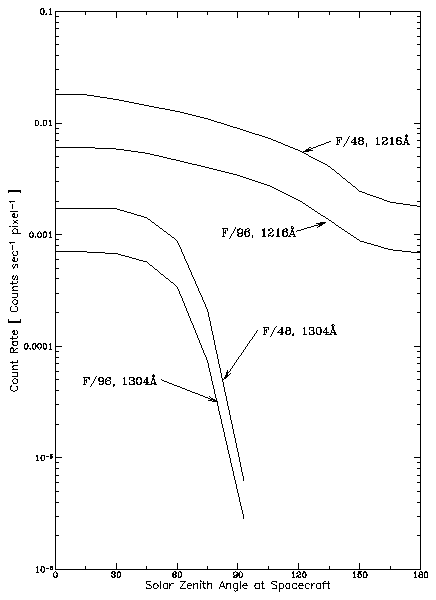
Table 7.1: Zodiacal Light Intensities in S10 Units*1
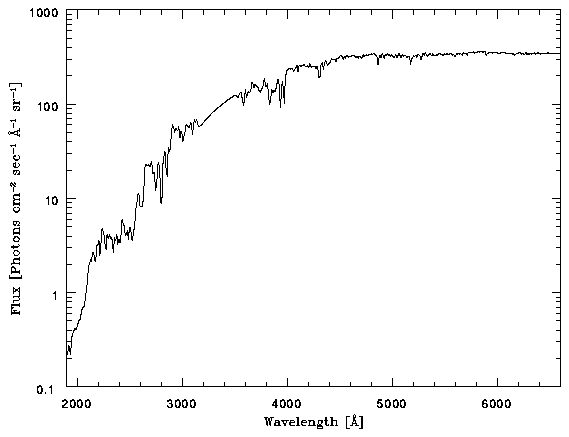
The second source of background is zodiacal light, which can be an important contributor to RB in the 3000--6000Å range. This contribution as a function of wavelength is plotted in Figure for the three relays. An intensity of 90 S10 units (@ 3 10-4 photons cm-2sec-1sr-1Å-1) and a standard solar spectrum is assumed in these calculations. This corresponds to a line of sight direction of ecliptic latitude b=40xfb and helioecliptic longitude l-l Q=85xfb . Thus, RB for the zodiacal light can be computed by multiplying the results shown in Figure by the appropriate nz T(l0)Dl and by the factor S/90 where S can be computed for any target position by means of the data tabulated by Levasseur-Regourd and Dumont (Astr. Ap., 84, 277, 1980) and reprinted here for convenience as Table 7.1. 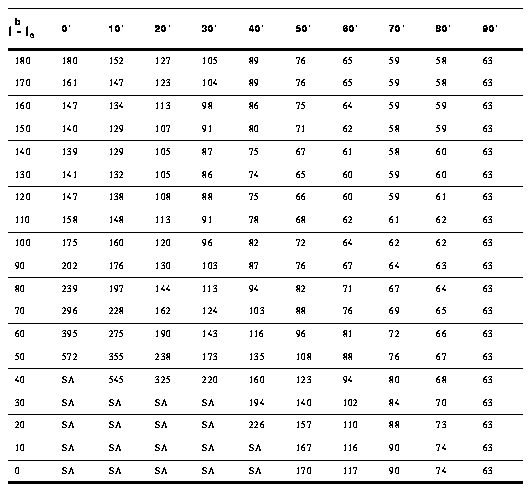
Figure 7.2: Zodiacal Light Contribution to the FOC Background wth no Filters for use in Eq. in counts sec-1 Å-1 sr-1 as a Function of Wavelength. The zodiacal light intensity has been normalized to be 1 S10 units..
Generated with CERN WebMaker