


Geometric distortion is a fact of life when dealing with detectors containing image intensifiers, primarily because intensifiers rely on an electric field for accelerating, and a magnetic field for focusing the photoelectrons. Any variation in the uniformity of either results in image distortion within the intensifier. Photon positions are then further distorted in the process of "reading-out" the TV tube's target, firstly because the read-out beam is performing an angular sweep across a plane target, and secondly because of non-uniformities in the scanning rate of the beam. For this reason, each video format has individual distortion characteristics, and so unfortunately, the distortion measured for one format cannot be used to correct the distortion of an exposure taken in another format.
In past cycles, the distortion correction model had been based on the measured location of the reseau marks--fiducial reference points etched onto the first of the bi-alkali photocathodes in the intensifier tube. (Since these reseau marks only transmit about 10% of the incident light, for all practical purposes they cannot be flat fielded out.) These reseau marks form an orthogonal grid of 17 rows and 17 columns with a separation of 1.5 mm (60 pixels), each reseau being 75 microns square (3 3 pixels). The detector distortion was determined by illuminating the photocathode with an internal light source, (i.e., an internal flat field). The observed positions of the reseau marks, when compared to the expected positions, provide a map of the detector distortion across the field. The optical component of the distortion is determined independently from ray-tracing models of the HST and FOC optics, and is applied to the reference reseau grid to give the "expected" positions.
Unfortunately, the detector distortion for the FOC clearly has variations on spatial scales smaller than the spacing of these reseau marks (particularly near the scan line beginning), and as a result, models based only on the reseau marks do not adequately represent the true distortion. A new method of determining distortion was developed which is based on overlapping observations of crowded starfields to determined the net distortion (the optical distortion is naturally included in this method of determining the distortion). These observations were then used to determine a two-dimensional spline distortion model which in turn was used to generate the new geometric correction files. The improvement in quality is most apparent for smaller formats where the small number of visible reseaux prevented the determination of a good model. The new geometric correction files have been used in the calibration pipeline for F/96 data since March 19, 1995 (F/48 geometric correction files are still based on reseau marks). As an aside, only those who desire sub pixel accuracy in position measurements or those who have used the 256 x 256 format should even consider reprocessing their old data with the new geometric correction files. For most, the improvements will not have a significant effect on their positions or photometry.
Although the geometric distortion arises from several sources, the correction of images is carried out in a single step using a flux-conserving algorithm which maps values from the raw, distorted image into a geometrically corrected image. Figures and show as an example the magnitude of the distortion field as determined for the pre-COSTAR F/48 and pre-COSTAR F/96 cameras using their 512z 1024 formats, from in-flight calibrations (the differences arising from the change in the new distortion and the optical distortion from the use of COSTAR amount to only a few pixels at most; these figures are intended to show the global distortion effects).
The squares show where a regular grid of points on the sky (using a 60 pixel spacing) should have appeared if there were no distortion; the ends of the line segments show where the grid points actually appear in the distorted image. (The lines have been multiplied by a factor of 2 to make them more easily visible, e.g., a line length of 50 pixels represents a distortion displacement of 25 pixels). The pixel coordinates shown refer to normal, square pixels, rather than the rectangular, zoomed pixel mode the images were obtained in.
In order to carry out geometric correction of FOC data, i.e., to recover an image in which the spatial relationships between objects are restored, a necessary requirement is that the geometric distortion field, shown in Figures and , must be stable. By this we mean that there must be no significant change in the observed reseau positions with time.
Figure 6.15:
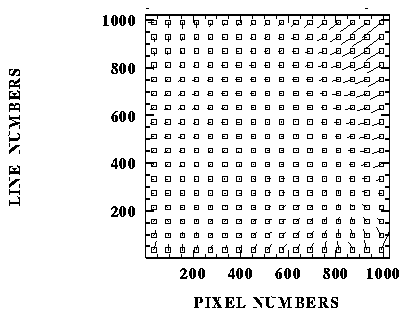
The 512z x 1024 Format Distortion Field for the F/48 Relay.Figure 6.16:
Short term variation of the geometric distortion pattern occurs during the period immediately following FOC high voltage switch-on. During this time the observed reseau positions show an RMS deviation from the stable positions of approximately 1-2 pixels. This period however, extends for only about 40 minutes, by which time the reseau position have stabilized to within 0.5 pixels, which is considered adequate for imaging purposes. In order to avoid this period of instability, the scheduling software automatically inserts a delay interval immediately following high voltage switch-on which prevents exposures being taken during this time. Long term variations in the geometric distortion were expected to occur as a result of desorption and out-gassing in the OTA and instruments, however given the time since launch, the desorption curve is now considerably flatter and out-gassing should be very near stable. Consequently, effects on distortion are much smaller and are taking longer to materialize. Based on our experience; 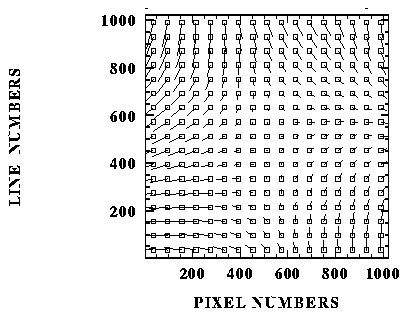
The 512z x 1024 Format Distortion Field for the F/96 Relay.
Generated with CERN WebMaker