


Figure 6.14: The Expected Monochromatic Count Rate as a Function of Wavelength for the F/96 Relay and the F231M Filter or the F231M+F220W Filters in the Beam for an Extended Source Whose Spectrum Varies as the Curve Marked SOURCE SPECTRUM. The source flux units are photons cm-2sec-1Å-1.
A striking example of a possible observing scenario that can be expected when imaging a bright visible source in the UV is shown in Figure 6.14. In the example shown in this figure, the source spectrum is assumed to increase sharply with increasing wavelength in the manner expected from an M supergiant star. If this source is fed into the F/96 relay with the F231M filter on FW#3 in the beam, the resulting monochromatic count rate as a function of wavelength through the entire OTA+COSTAR+FOC system is shown by the curve marked F231M. The actual observed count rate in this configuration, of course, corresponds to the integral of this curve.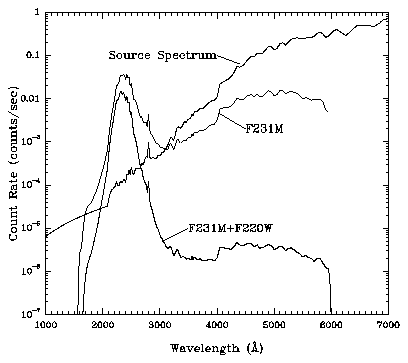
If the F231M filter alone is used in this endeavour, the contribution of the flux within the band 2330 xb1 115Å is only @ 18% of the total of 39 counts sec-1. The counts originating from the region l > 2580Å represent, in contrast, 71% of the total. In this admittedly extreme case, the thus derived UV brightness would be highly suspect, to say the least. Solutions to this problem are not easy to find but, at least for the F/96 relay, one simple device would be to introduce a second cleverly selected filter into the beam in addition to the original one. This selection should be geared towards maximizing the suppression of the visible leak while minimizing absorption in the UV bandpass of interest.
In the case worked out in Figure 6.14, for example, the F220W filter on FW#2 is ideal as shown by the curve marked F231M+F220W. Now, the in-band fraction of counts amounts to 69% while the visible leak is only 5% or less of the total. The exposure time required to reach a S/N=10 in this case increases by a factor of six mainly because of the effective suppression of the visible counts.
Unfortunately, the F/48 relay with its much smaller filter complement has far less flexibility in this regard than the F/96 relay. In this case, another possible solution to the problem is to use the objective prisms to physically separate the UV from the visible. This technique works best for point or, at least, compact sources where spatial and spectral overlap is minimized. But even for extended sources, appropriate positioning of the target with respect to the dispersion axis of the prism can work quite well. At that point, the only remaining problem is to insure that the overload limit of the detector (described in "Detector Overload" on page 79) is not violated for the visible part of the image.
Generated with CERN WebMaker