Signal to noise Calculation
The signal generated by a continuum source with a flux Fj [Jansky] falling on a pixel is:Cc = Fj
 optdetfiltAprimE
=Fj
 c [e-/sec]
where:
Signal to noise Calculation
The signal generated by a continuum source with a flux Fj [Jansky] falling on a pixel is:optdetfiltAprimEc [e-/sec]where:
opt is the efficiency of the optics, including the HST mirrors and the -NICMOS optics.
det is the detector quantum efficiency.
filt is the filter transmission.
 )
)
where h is Planck's constant andThe expression for Cc has to be integrated over the bandpass of the filter, since some of the terms vary significantly with wavelength. The value for
c is listed for each filter in Tables 6.3, 6.4, and 6.5, so that the signal in e-/sec can be estimated. It should be noted that to determine Cc more accurately, the source flux F should be included in the integral over the filter bandpass, since the source flux is bound to be a function of wavelength. This has been done, assuming a source effective temperature of 5,000K.
If an emission line falls in the bandpass of the filter, we need to take account of its effect on the signal (in some cases the emission line may generate almost all the detected signal). The line signal can be determined as:
optdet,filt,AprimE
 Iij [e-/sec]
where E is defined as before. However, on this occasion it is necessary to use a line flux I (in Wm-2), and the detector quantum efficiency and filter transmission are determined for the wavelength
The factor of the emission line. is plotted by the Exposure Time Calculator. Thus one only needs to pick the wavelength of interest, read off , and multiply your flux, Ilj,by this to get the line contribution to the flux in the filter. The maximum value of , denoted as ,^ is also listed in Tables 6.3, 6.4, and 6.5. Note that for the grisms, where both lines and continuum will frequently be present, we have plotted in units of e-/sec/Jansky. Thus, in this case it is necessary to estimate the spectral flux density of any line emission in Janskys, which is done simply by using the line strengths and the spectral resolution of the grisms.
The total signal generated by the pixel is the sum of the continuum and line signals calculated above.
The final ingredients needed to calculate the signal to noise for the observation are the read noise Nr and dark current Id. The read noise can be taken from Table 7.1. The dark current has not been very well determined at the time of writing, but we recommend that the upper limits listed in Table 7.1 should be adopted.
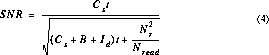
It is now possible to calculate the signal to noise ratio expected for an exposure of duration t seconds, where a number Nread of reads are taken before and after the integration. It is:

Software Tools
Rather than going through all the above calculations by hand for every source on an observing list, software tools can be used. The tools are available on the NICMOS World Wide Web page, and can be found by following the Software Tools link.
 These tools should be regarded as the official calibration of NICMOS for purposes
of preparing Phase I observing proposals and should be used rather than the values
presented above, if at all possible.
These tools should be regarded as the official calibration of NICMOS for purposes
of preparing Phase I observing proposals and should be used rather than the values
presented above, if at all possible.
Filter Sensitivity Curves
The first of the tools available will calculate the flux required as a function of time to achieve a given signal to noise for any NICMOS filter. Two versions of this tool are available, one for point sources and one for extended sources. Signal to Noise for a Source
For a particular source, with a known flux density or surface brightness, there are a pair of tools. These perform very similar calculations to those described above, with the output being signal to noise against time. Currently the source flux must be for the wavelength of the filter; eventually bells and whistles will be added so that you can enter the flux at one of the standard IR photometric bands (I, J, H or K). Saturation and Detector Limitations
The signal to noise which can be achieved in a given time is one indication of how useful an observation is likely to be. However, there are two further pieces of information which are important to know, and which are not readily apparent from the mere knowledge of signal to noise: firstly, is the detector operating in its linear response range, and secondly, what is limiting the signal to noise? A further pair of programs generate this information for each filter. These generate both the flux (or surface brightness, as appropriate) above which the observation is limited by photon noise (either from the source or the background) rather than detector noise, and the flux above which the observation enters the non-linear detector operation regime, which we refer to as saturated.