Figure 7.1: DQE Versus Wavelength for Flight Arrays (solid line is NIC1, broken line NIC2, NIC3 is not plotted but is similar to the other two). Note that these curves reflect prelaunch measurements. 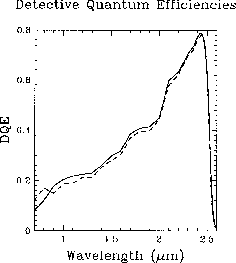
The fine details in these DQE curves should not be interpreted as detector features, as they may be artifacts introduced by the test set-up used to measure them. At the blue end, near 0.9 microns, the DQE is ~15%, and rises quasi-linearly up to a peak DQE ~80% at 2.4 microns, after which there is a rapid decrease to zero at 2.6 microns. The NICMOS arrays are blind to longer wavelength emission. When looking at these DQE curves, bear in mind that this is not the only criterion to be used in determining sensitivity in the near-IR. For example, thermal emission from the telescope starts to be an issue beyond ~1.6 microns. The shot-noise on this bright background may degrade the signal to noise obtained at long wavelengths, negating the advantage offered by the increased DQE.It is very important, especially for observations of very faint targets where the expected signal to noise is low, to note that the DQE presented here is only the average for the entire array. The flat field response described in detail later is non-uniform, and thus the DQE curves for individual pixels may be rather different.
The individual pixels in the NICMOS arrays are completely independent, and they do not suffer from the charge transfer effects present in CCDs, or from bleeding if the wells are filled due to over exposure. They do however have read-noise as well as their own special detector artifact, shading.