[Top] [Prev] [Next] [Bottom]
Detector Artifacts
Shading
The NICMOS arrays exhibit a noiseless signal gradient, a kind of pixel-dependent bias, orthogonal to the direction of primary clocking, called shading.
The shading effectively changes the bias level for the pixels as a function of time. The amplitude of the shading can be as large as several hundred electrons for some pixels under some circumstances. Through analysis of a considerable volume of on-orbit dark data, we have determined that for a given pixel the bias level introduced by the shading is dependent on the time since the last read of the pixel. Thus if the time between reads remains constant, the bias level introduced by the shading remains constant. For MULTIACCUM readout sequences where the time between readouts is increasing logarithmically, the bias level changes with each successive read, and thus the overall shading pattern evolves with readout. The first pixels to be read show the largest bias changes, and so the overall shading pattern is a DC offset which is roughly an exponential function of row number (it also varies along each row in a roughly exponential manner). The shading exhibits all the characteristics of a bias change, including lack of noise: the noise introduced by the shading is too small for us to measure.
We have calibrated the dependence of shading as a function of time between reads for each of the three NICMOS detectors using on-orbit darks, and are now able to use this information to construct "synthetic" dark current calibration reference files for all MULTIACCUM readout sequences. The accuracy of this calibration is good (a few percent for most readout times).
Amplifier Glow
Each quadrant of a NICMOS detector has its own readout amplifier, which is situated close to an exterior corner of the detector. When a readout is made, the amplifier injects a real signal into the detector, known as amplifier glow. This signal is largest closest to the corners of the detector where the amplifiers are situated, and falls rapidly towards the center of the detector. The signal is only present during a readout, but is repeated for each readout of a MULTIACCUM sequence. We have now calibrated the amplifier glow signal for each of the detectors; for each readout, the amplitude of the amplifier glow signal is of order one hundred electrons in the corners of the detector, and of order ten electrons close to the center. The signal is highly repeatable, and almost exactly linearly dependent on number of reads (however, there is some minor evidence that there may be a small non-linearity for reads made very close together in time; the amplitude of this non-linearity typically amounts to only a few electrons accumulated over an entire MULTIACCUM exposure in the brightest parts of the amplifier glow signal, however, so that our detection of this non-linearity is marginal). However, this is a real signal, and is subject to photon statistics, so it is a source of noise in NICMOS exposures. Thus, for the case of an ACCUM exposure with multiple and initial and final reads, although the multiple reads reduce the effective read noise of the observation, they also contribute extra photon noise via the amplifier glow, so that the gain in noise is in the end smaller than might be expected, and strongly dependent on location in the detector field of view (close to the corners the noise will actually increase). Similarly, making excessive numbers of reads in a MULTIACCUM exposure will add noise via the amplifier glow, so that the trade-off between improved Cosmic Ray rejection, reduced read noise, and increased photon noise in the final image is a complicated one.
Read-Noise
Each detector has four independent readout amplifiers, each of which reads a 128 x 128 quadrant. The four different readouts each generate very similar amounts of read noise to one another-this is illustrated in Figure 7.2, where the read noise distributions for the 1st and 4th quadrants of the Camera 1 array are compared. The distribution of read noise values for all the pixels in a given quadrant is relatively narrow (see Figure 7.2; a FWHM of 8 electrons is measured), so that there are very few very noisy pixels in these arrays (if the distribution were very broad, calculations of expected signal to noise values, which were critically dependent on the read noise, would be misleading).
Figure 7.2: Read Noise Characteristics for Two Quadrants on Camera 1 Detector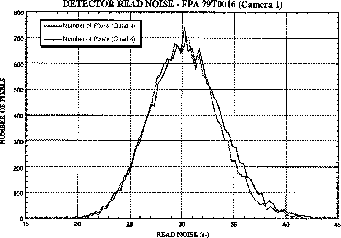
Linearity and Saturation
Ground-testing of NICMOS indicated that the detector response is slightly non-linear over most of the useful dynamic range. Saturation has been defined as when the response deviates by more than 5% from a linear fit: this is seen to occur for most pixels at about 90% of full well. We find that a deviation of more than 0.5% from linearity occurs at about 15% of full well. The response curve is well fit by a second order polynomial, which is used to correct observations in the calibration pipeline. At the time of this writing, on-orbit tests of the linearity are expected to be carried out shortly.
Effects of Overexposure of the NICMOS Detectors
Overexposure of the NICMOS detectors will not cause permanent harm and therefore NICMOS does not have bright object limitations. However, two artifacts result from exposures that overexpose one or more pixels:
Effect of Cosmic Rays
As with CCDs, cosmic ray hits will produce unwanted signal in the output images, but hot pixels are not expected to develop from such hits. The NICMOS arrays have been subjected to radiation doses much higher than expected in their entire lifetime in accelerator tests without sustaining any long-term damage or measurable depreciation in DQE. Hence, cosmic rays should have little impact on the long-term array performance in orbit.
On-orbit measurement of the distribution of cosmic rays shows 1.2 to 1.6 events/second/Camera for 5 sigma events. With a typical event generating a >=5 sigma event in ~2 pixels, this corresponds to 2 to 3 pixels/second/Camera. For a 2000 second integration, about 10% of the pixels in the detector will show cosmic ray events.
Therefore, the frequency of cosmic ray hits is large enough that we recommend the use of MULTIACCUM (or multiple ACCUM images) for all exposures longer than ~10 minutes, in order to filter out cosmic rays. MULTIACCUM provides a series of intermediate non-destructive reads as well as the final image (see Chapter 8). These intermediate reads can be used to identify cosmic ray hits, analogous to the use of CRSPLITs in WFPC2 or STIS observations. The calibration pipeline, described in Chapter 13, can identify and remove cosmic ray hits from MULTIACCUM observations.
Intra-Pixel Sensitivity Variations
As with many other modern array detectors, the sensitivity of the NICMOS detectors is lower near the edges of pixels then in their centers. It is as though there were very small regions of reduced sensitivity along the intra-pixel boundaries. This means that the response of a pixel to a source whose flux changes rapidly on a size scale comparable with or smaller than the pixel size will depend on where the center of the source lies with respect to the center of the pixel. Since the latter is not known a priori, this effect will introduce some uncertainty in the flux calibration for a point source. This uncertainty will be largest for Camera 3 at short wavelengths, for which the PSF is undersampled. We will try to measure the size of this effect on orbit, but we expect it to be no more than a few percent uncertainty for Camera 3.
[Top] [Prev] [Next] [Bottom]
stevens@stsci.edu
Copyright © 1997, Association of Universities for Research in Astronomy. All rights
reserved.
Last updated: 07/24/97 15:32:42