
NICMOS Instrument Handbook for Cycle 11
 |
 |
 |
 |
|
| NICMOS Instrument Handbook for Cycle 11 | |||
|
Layout
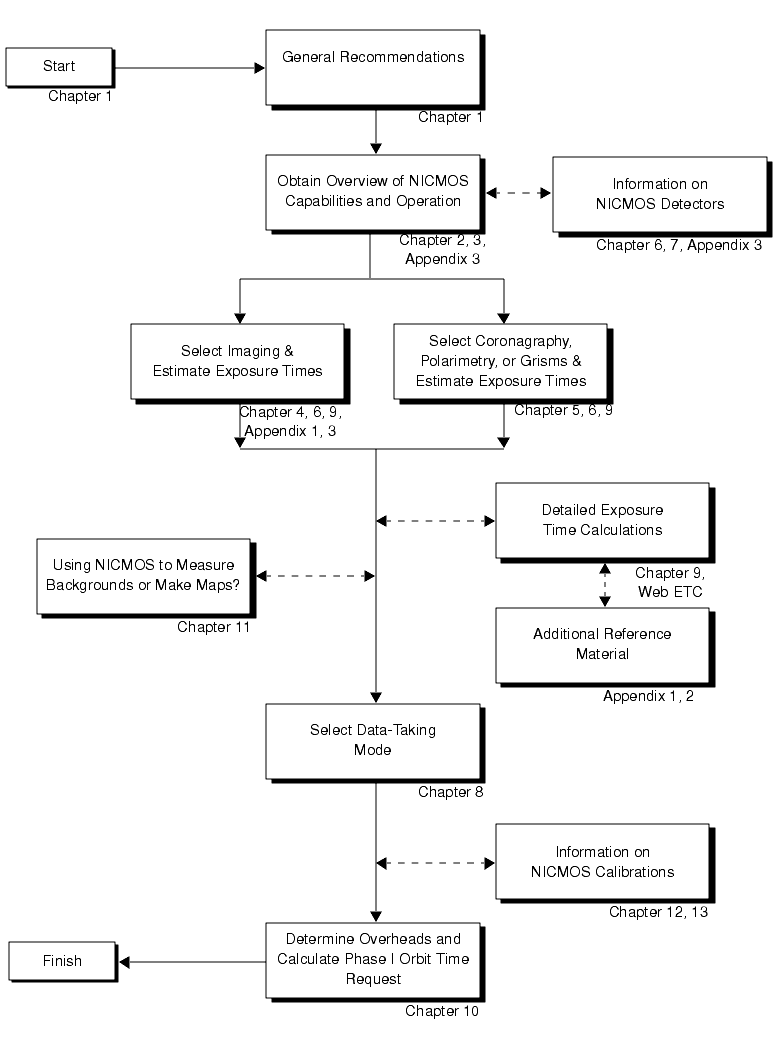
NICMOS provides direct imaging in broad, medium, and narrow-band filters at a range of spatial resolutions in the near infrared from 0.8 to 2.5 microns, together with broad-band imaging polarimetry, coronographic imaging and slitless grism spectroscopy. To guide the proposer through NICMOS's capabilities and help optimize the scientific use of the instrument we have divided this Handbook into five parts: Introduction; User's Guide; How to Plan an Observation; Calibration Overview; and Appendices. Figure 1.1 provides a road map to navigating the document.
The chapters of this Handbook are as follows:
- Chapter 1, describes the Handbook layout, where to find help and additional documentation, and important advice for preparing NICMOS proposals.
- Chapter 2, provides an introduction to the expected capabilities of NICMOS under NCS operations, the basic physical and imaging layout, a description of the NCS, and a summary of the detectors' operations.
- Chapter 3, shows in tabular form the required steps for designing a NICMOS observing program, guides users through some of the technical details for choosing the optimal configuration for a given observation, and provides the reader with a "map" for the subsequent chapters.
- Chapter 4, provides a description of NICMOS's imaging capabilities including camera resolutions and throughputs, image quality and effects of cosmic rays. Described here is also the infrared background seen by NICMOS.
- Chapter 5, provides detailed information on coronagraphic imaging, grism spectroscopy, and polarimetry.
- Chapter 6, describes the aperture definitions and the sky-projected orientation of the instrument.
- Chapter 7, describes the basic properties of the detectors used in the three cameras including their physical characteristics, capabilities and limitations. Performance descriptions are based on expectations under NCS operations.
- Chapter 8, explains the data taking modes which take advantage of the non-destructive readout capabilities of the NICMOS arrays. While nearly all observers will choose to use
MULTIACCUMmode, we give descriptions of other modes to help proposers/users choose the most appropriate ones for their observations.
- Chapter 9, describes how to perform signal to noise calculations, either by using pencil and paper, or using software tools that are provided on the World Wide Web (WWW).
- Chapter 10, provides information to convert from a series of planned science exposures to an estimate of the number of orbits, including spacecraft and NICMOS overheads. This chapter applies principally to the planning of Phase I proposals.
- Chapter 11, describes the implementation of a pre-defined set of patterns which accomplish dithering and chopping from the field of interest, and allow easy generation of large mosaic images.
- Chapter 12, briefly describes the processing of NICMOS data by the STScI pipeline and the data that will be sent to observers.
- Chapter 13, summarizes the accuracies expected for NICMOS data calibrated by the STScI pipeline during Cycle 11, and gives an overview of the Cycle 11 calibration plan.
Figure 1.1: Roadmap for Using the NICMOS Instrument Handbook
- Appendix 1, provides summary information, filter transmission curves, and sensitivity plots for each imaging filter, ordered by camera and increasing wavelength.
- Appendix 2, provides formulae and tables for the conversion of flux units, and a list of common infrared spectral lines.
- Appendix 3, describes the BRIGHTOBJ read-out mode.
|
Space Telescope Science Institute http://www.stsci.edu Voice: (410) 338-1082 help@stsci.edu |
| |
|
|
|