
NICMOS Instrument Handbook for Cycle 11
 |
 |
 |
 |
|
| NICMOS Instrument Handbook for Cycle 11 | |||
|
Calculating NICMOS Imaging Sensitivities
In some situations it may be desirable to go through each step of the calculation. One example would be the case of a source with strong emission lines, where one wants to estimate the contribution of the line(s) to the signal. This could include the case of a strong emission line which happens to fall in the wing of a desired filter's bandpass. To facilitate such calculations, in this section we provide recipes for determining the signal to noise ratio or exposure time by hand.
Signal to noise Calculation
The signal, in e-/s, generated by a continuum source with a flux

is the transmittance of the entire optical train up to the detector,
excluding the filters;
is the detector quantum efficiency;
is the unobscured area of the primary;
where h is Planck's constant and
the wavelength. The quantities Fj,
opt,
For an emission line with intensity Ilj (in W m-2 pixel-1) falling in the bandpass of the filter, the counts in e-/s are given by:

where E is defined as before. In this case, the detector quantum efficiency and filter transmission are determined for the wavelength
The values for
c and
l are listed in Table 9.1, 9.2, and 9.3 for two limiting cases of NICMOS operation in Cycle 11, namely a detector temperature of 75 K without the elevated dark current and a detector temperature of 78 K with elevated dark current. In Appendix 1, we show the resulting sensitivity curves for both cases.
The source signal is superimposed on sky background and thermal background from warm optics. At
The other components of unwanted signal are read noise, Nr, and dark current, Id (in e-/s/pixel). By read noise, we mean the electronic noise in the pixel signal after subtraction of two reads (double correlated sampling).
It is now possible to calculate the signal to noise ratio expected for an exposure of duration t seconds, where a number Nread of reads are taken before and after the integration in a MIF sequence. It is:

Where Cs, the count rate in e-/sec/pixel, is the sum of Cc plus Cline, B is the background in e-/sec/pixel (also listed in Table 9.1, 9.2, and 9.3), Id is the dark current in e-/sec/pixel and Nr is the read-out noise, in e-/pixel, for one initial and one final read. We represent the effectiveness of multiple initial and final reads at beating down readnoise by the function f(Nread), which is unity for Nread= 1, and decreases with the number of reads for Nread
9. This function is not well determined at present, so we use a parabolic curve with a minimum at 9 reads of 20 e-, and has a value of 30 e- at 1 read.
It is important to note that in these equations, the flux to be entered (either Fj or Ilj or both) is not the total source flux, but the flux falling on a pixel. In the case of an extended source this can easily be worked out from the surface brightness and the size of the pixel. For a point source, it will be necessary to determine the fraction of the total flux which is contained within the area of one pixel and scale the source flux by this fraction. For Camera 1 in particular, this fraction may be quite small, and so will make a substantial difference to the outcome of the calculation. Appendix 1 gives the fraction of the PSF falling in the brightest pixel assuming a point source centered on the pixel, for each filter.
The signal to noise ratio evaluated by a fit over the full PSF for point sources would, of course, be larger than this central pixel SNR; this discrepancy will be largest for the higher resolution cameras and for the longest wavelengths. Appendix 1 provides SNRs and exposure times calculated in reference apertures of 1" for NIC1 and NIC2, and 2" for NIC3 to account for this effect.
Saturation and Detector Limitations
Given a particular filter-detector combination and a requested target flux, there is an exposure time above which the observation ceases to be read noise limited. There is also an exposure time above which the detector starts to saturate. The WWW NICMOS ETC will produce these two fluxes or exposure times (as appropriate) when it performs the requested estimation. The sensitivity plots of Appendix 1 report saturation curves.
Exposure Time Calculation
The other situation frequently encountered is when the required signal to noise is known, and it is necessary to calculate from this the exposure time needed. In this case one uses the same instrumental and telescope parameters as described above, and the required time is given by:
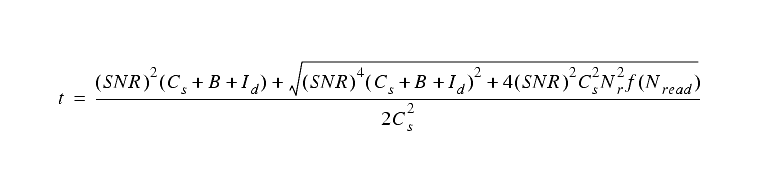
Sensitivity curves for fixed SNRs (SNR=3 and SNR=10) are given in Appendix 1 for both point sources and extended sources.
Table 9.1: NIC1 Filter Sensitivity Parameters (per pixel) F090M F095N F097N F108N F110M F110W F113N F140W F145M F160W F164N F165M F166N F170M F187N F190N POL0S
Table 9.2: NIC2 Filter Sensitivity Parameters (per pixel) F110W F160W F165M F171M F180M F187N F187W F190N F204M F205W F207M F212N F215N F216N F222M F237M POL0L
|
Space Telescope Science Institute http://www.stsci.edu Voice: (410) 338-1082 help@stsci.edu |
| |
|
|
|

 is the filter transmittance;
