High-velocity clouds
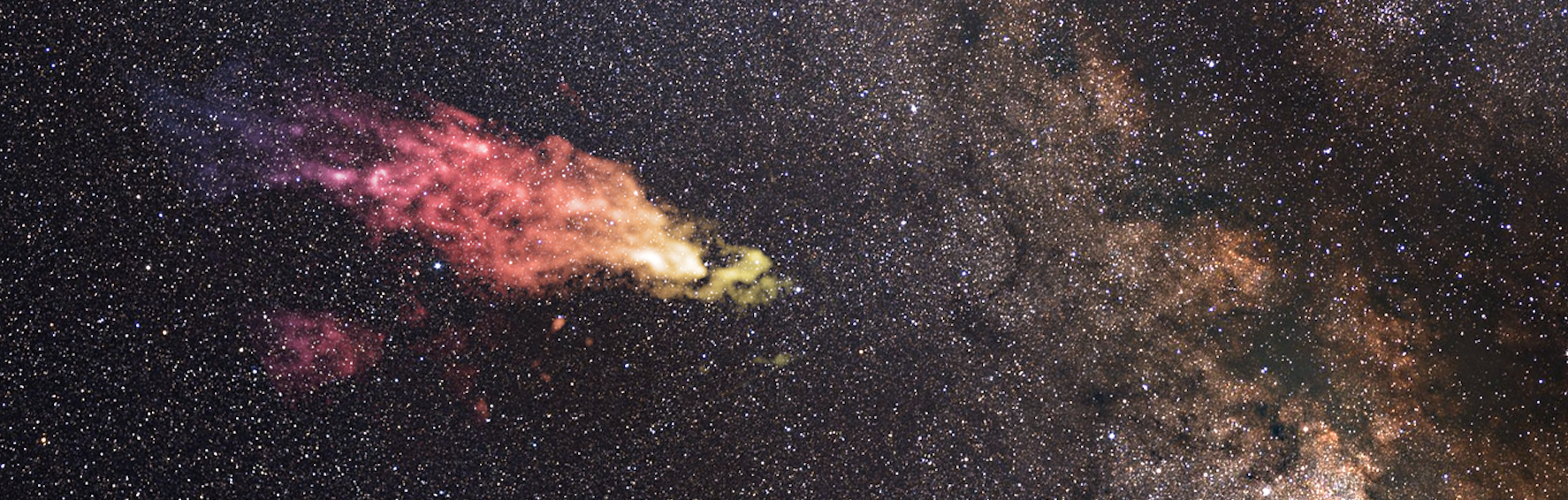
High-velocity clouds (HVCs) are a population of gaseous clouds in the halo of the Milky Way. They are defined to have velocities that do not co-rotate with the Galactic disk. HVCs trace the gas flows onto and away from the Galactic disk, and therefore play an important role in the Milky Way's baryon cycle. For many years, our group has been measuring their properties, including chemical composition and ionization state. Two examples are discussed on this page: the Smith Cloud and Complex C.
The Smith Cloud
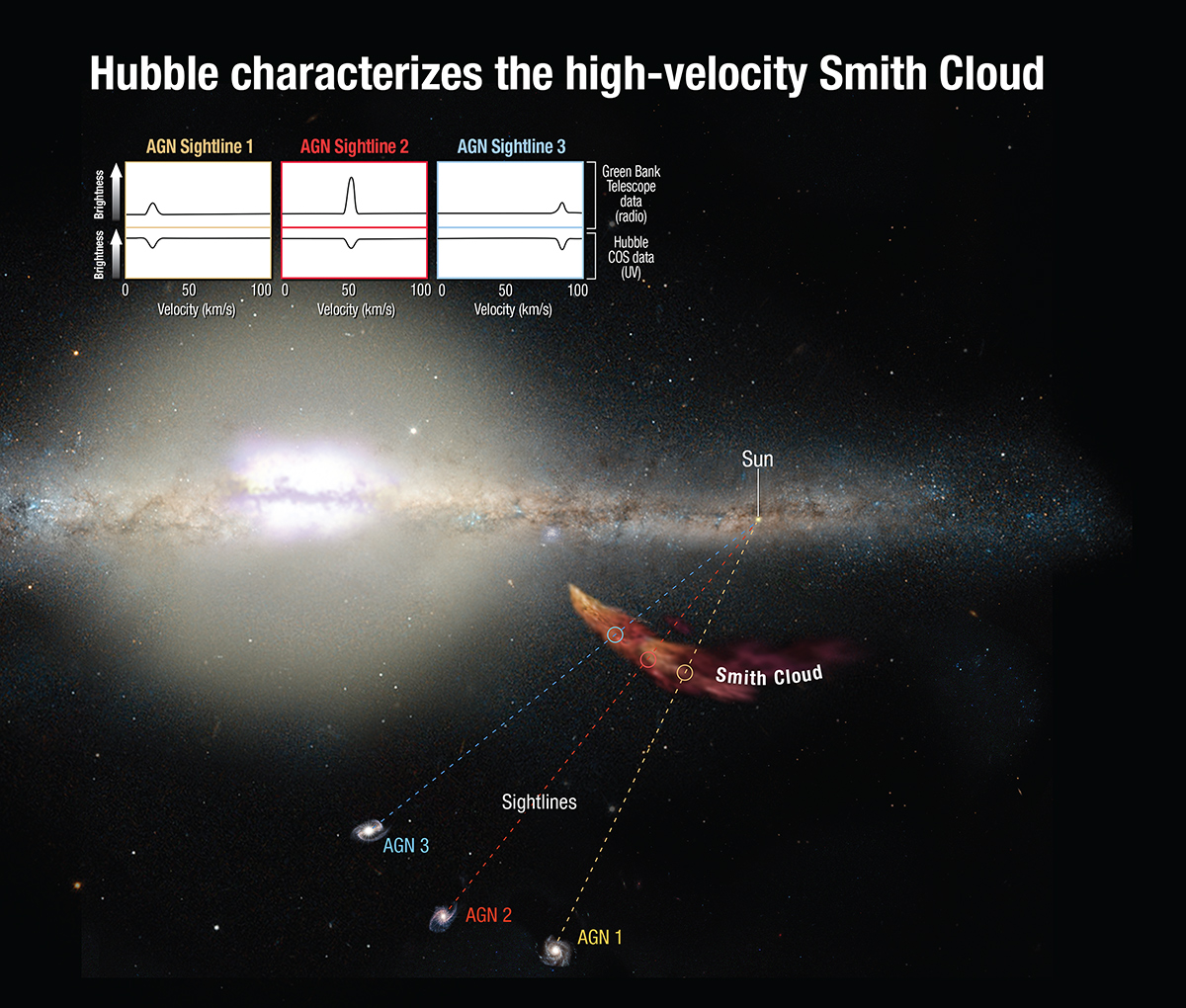
The Smith Cloud is an infalling high-velocity cloud (HVC) on its final approach to the Galactic disk. It is expected to impact the disk within 30 million years, and parts of it are already showing signs of interaction. Its origin is unknown. We used the Hubble Space Telescope to measure its chemical composition and kinematics and probe its source, and found that its metallicity was surprisingly-enriched, to approximately one half of the solar level. This level of chemical enrichment suggests that Galactic processes (like feedback from star formation) have enriched the cloud, rather than it being pristine intergalactic gas. See our 2016 paper in the Astrophysical Journal Letters and NASA press release, shown in the graphic below.
Complex C
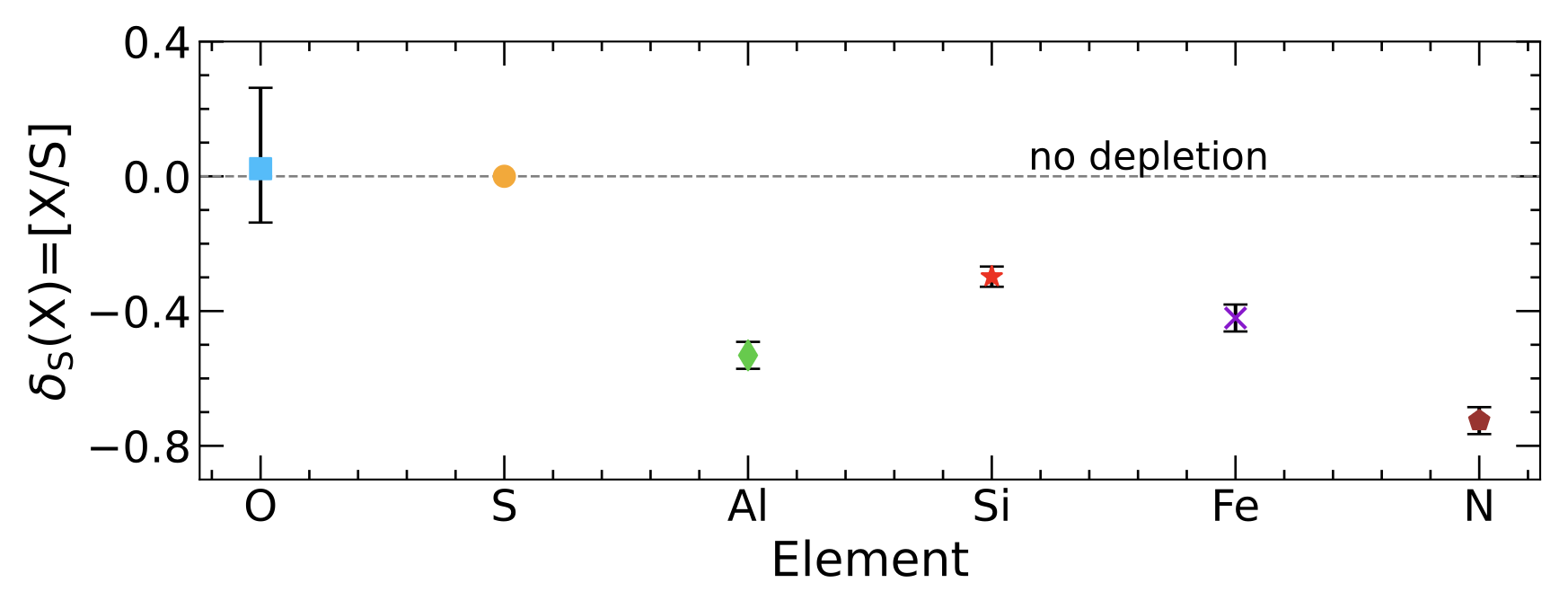
Complex C is a massive, infalling, low-metallicity high-velocity cloud in the northern Galactic hemisphere that traces the ongoing accretion of gas onto the Milky Way. In our 2023 Letter in the Astrophysical Journal we showed that Complex C contains dust, as revealed by non-solar abundance ratios of iron-to-sulfur, silicon-to-sulfur, and aluminum-to-sulfur (see image below). This is important as it demonstrates that Complex C is not a pristine cloud, but has been enriched relatively recently. The combination of low metallicity and dust depletion in Complex C presents challenges to chemical enrichment models. We are further exploring the dust depletion properties of HVCs in HST Program 17569, led by former group member Francie Cashman.