
Who We Are
Click here to meet our group.
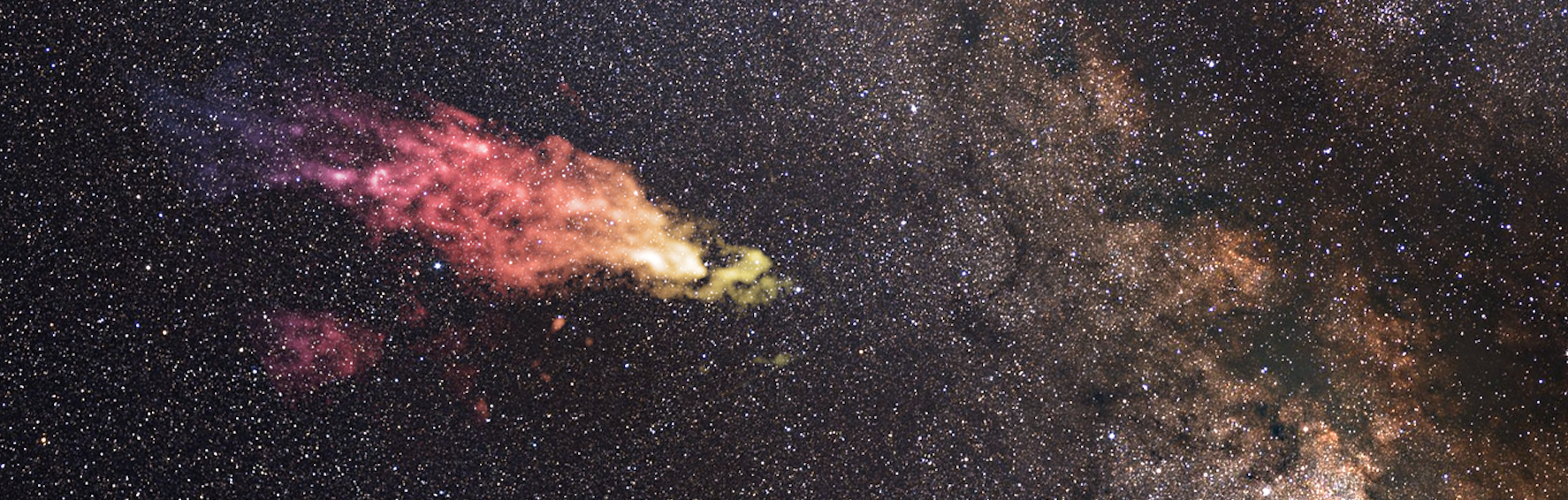
Our research group at STScI studies the gaseous halo of the Milky Way to better understand the Galactic ecosystem. By characterizing the gas flows between the Galactic disk and halo, we can probe the baryon cycle in more detail than is possible in any other galaxy. We address one of the central questions of NASA Astrophysics: how did we get here? Our group is largely observational and multi-wavelength, making heavy use of UV spectroscopy from the Hubble Space Telescope, radio spectroscopy from the Green Bank Telescope, and optical spectroscopy from various ground-based telescopes, but we also make use of photoionization modeling and hydrodynamical simulations. We are part of the Low Density Universe community at STScI, which includes several research groups working on related topics. We welcome new collaborators at all career stages. Five of our ongoing research projects are described below, together with a link to our current group members.
Click here to meet our group.

We study the Galactic nuclear outflow and the Fermi Bubbles.

We use spectrocopy to study this enormous tidal feature stripped off the Magellanic Clouds and heading toward the Galaxy. Click here to learn more.

We use H I absorption to probe diffuse gas in the Galactic disk and halo.

High-velocity clouds (HVCs) are a population of gaseous clouds in the halo of the Milky Way. We have been measuring their properties, including chemical composition and ionization state.

We have helped develop models of the Galactic ionizing radiation field, used for photoionization models of halo clouds.