ESA/AURA Astronomer
In Baltimore :
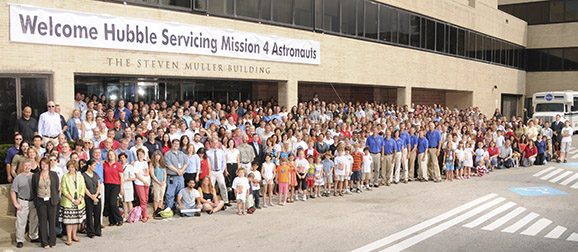
I joined the Space Telescope Science Institute in August 2013 as a staff astronomer. I am now sharing my time between functional work and massive time research. As part of the COS and STIS team, I support the UV and optcal spectrographs on board the Hubble Space Telescope. Most of my research time is devoted to massive stars research, to further the training of my PhD students in Amsterdam and to attract young promising scientists at Space Telescope.
NWO postoc: 2010-2013
In Amsterdam :In 2009, for the 4th year of my ESO fellowship, I choose to join the team of Prof. Alex de Koter at the Amsterdam University. Since 2010, I pursued my activities in Amsterdam as a NWO postdoc. One of my main task consists in quantitative analysising of a large sample of massive O star spectra obtained in the framework of the VLT-FLAMES Tarentula survey. Another key line of research has been to use complementary observational techniques (spectroscopy, interferometry, adaptive optics) to investigate the multiplicity properties of massive stars, leading to recent breakthrough in our understanding of the evolution of higfh-mass stars.
ESO fellowship: 2006-2010
Read more about my ESO experience here.In Santiago :
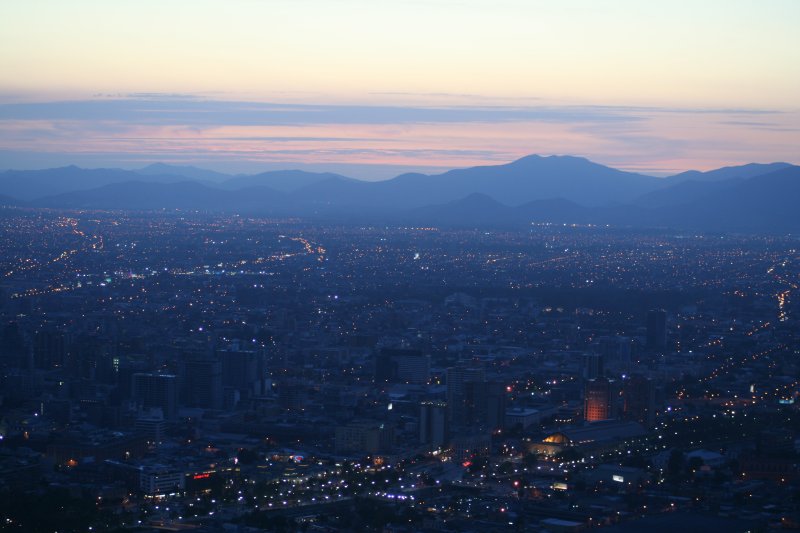
When not on duties in one of the ESO observatories, the ESO astronomers are pursuing their own research program in the Vitacura offices, in Santiago. My own research topics focuses on massive stars, which I studied using a wide range of observing techniques. As massive stars are mostly found in star clusters, I developed a second interest in stellar clusters and in the various stellar population they are hosting. To stimulate the ESO/Chile research in this field, we have further founded and are animating a discussion group on Stellar Clusters with about 15 regular attendees. With over 60 astronomers working in all areas of astrophysics, ESO-Vitacura is a very stimulating place where it is always possible to find a knowledgeable colleague.
At the Paranal Observatory :
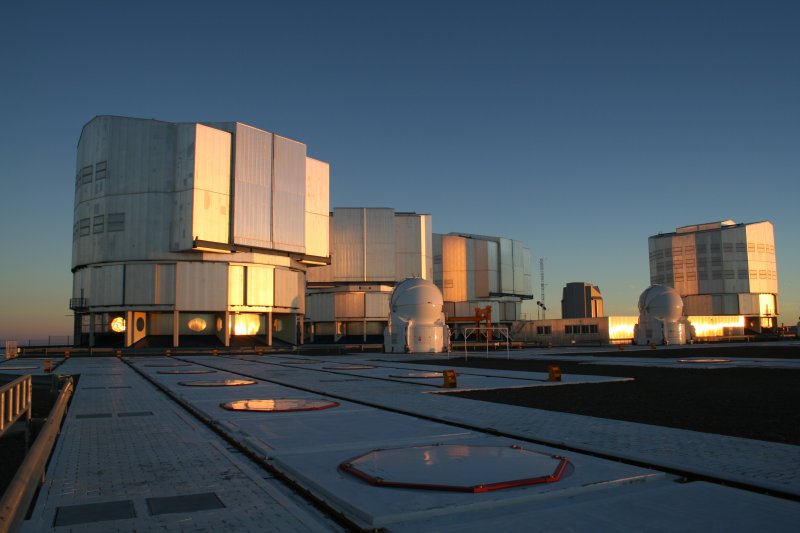
Beside the importance of the support astronomer task for the astronomical community at large, the time spent at Paranal has allowed me to gain a tremendous observational experience with 8-m class telescopes and with the related instrumentation. As a fellow, our duties put us in direct contact with the 13 instruments that equip the VLT/VLTI, encompassing techniques such as optical and IR imaging (including fast-timing mode), low- and high-resolution spectroscopy (long-slit, fibers, multi-object and IFU), (spectro-)polarimetry and interferometry. Some of these techniques are further coupled with Adaptive-Optics facilities that, as far as spatial resolution is concerned, are arguably one of the major technical breakthroughs in the last 10 years and will be a necessary component of the next generation of giant ground-based telescopes.
Instrumental experience :
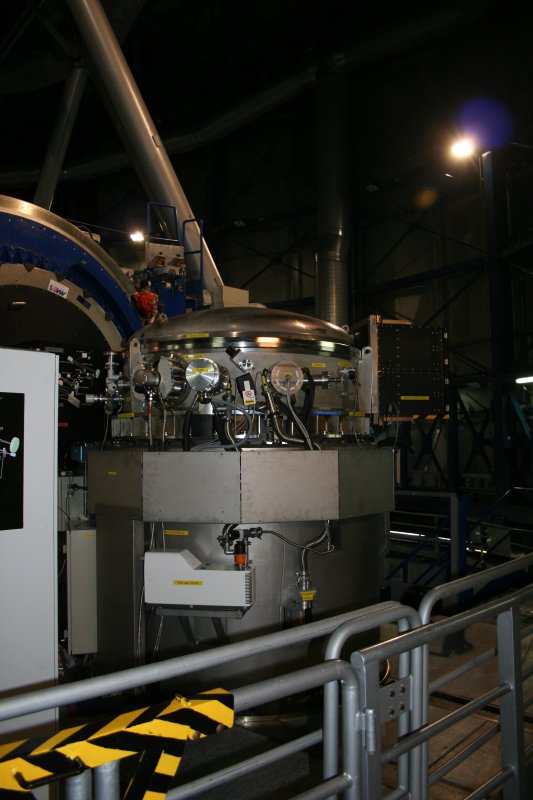
First as a CRIRES Fellow, then as the UVES Instrument Scientist, the ESO fellowship has definitely allowed me to deepened my knowledge of optical and infra-red high-resolution spectroscopy. Making an instrument to work at the best of its performance is not a task that can be achieved alone. This requires a continuous and coordinated effort from all the people from the Instrument Team, that provides the required expertise, from IT to engineering and instrument development, from scientific expertise to user support, data handling and quality control.
PRODEX postdoc : 2005-2006
Spent at the Liège University, I dedicated my time in publishing the results of my Ph.D. while continuing analysing some XMM-Newton data and on studying several massive binaries. I also spent some of my time looking for further horizons, which finally led me to cross the ocean, towards one of the most remote place on Earth: the Paranal observatory.Ph.D. in Liège : 1999-2005
I started my Ph.D. in 1999, in the High Energy Group of the Liège University in Belgium (at that time, the Massive Stars Group), first as a PAI, then as a Prodex researcher. After two years, I was allocated a FNRS grant that covered 4 more years. Since that time, I had been sharing my time between teaching duties, observation trips and data analysis. My main research topics focused on a multiwavelength study of a young open cluster, NGC 6231, with an emphasize on its early-type star population. I mostly used the complementarity provided by ground-based optical spectroscopy, mostly from the ESO-FEROS spectrograph, coupled with X-ray spectrophotometry from XMM-Newton, the large European X-ray observatory. This unique (and gigantic for the time) data set allowed me to revise the physical properties of the O-star population of the cluster, to bring to light new colliding-wind binaries and to study the cluster low-mass star population and its star formation history. As award-winner of a travel grant from the Communautée Française de Belgique, I also spent three months at the Birmingham University to gain experience in hydrodynamical simulations of colliding wind binaries.Physics studies: 1995-1999
I started studying physics in 1995 at the Namur University in Belgium, where I stayed for 2 years. In 1997, I moved to the Liège University that had a much stronger group in astrophysics. I graduated in June 1999, with a master thesis dedicated to a spectroscopic analysis of two O-type binaries. Two months later, I was further obtaining the Agrégation in Physical Sciences, the pedagogic acredidation diploma allowing to teach at high school level.STScI Muller building
UvA Science building
Santiago by Night
Paranal Observatory
CRIRES @ VLT/Antu