Southern Massive Sar
at High angular resolution: the SMaSH+ survey
Combining two of the highest angular resolution
techniques that exist, namely long-baseline
interferometry and sparse aperture masking, we are
engaged in a large scale survey of the Southern sky
galactic massive stars. Using PIONIER and
NACO/SAM at the VLT(I), we aim at constraining for the
first time the multiplicity of nearby massive stars in
the separation range 1.5-200 milli-arcsecs
(corresponding to physical distances of 1.5-600 AU at
1-3~kpc) and flux contrasts in the range 1:100 (5
mag). The separation range investigated will be
extended up to 200~mas using existing and
complementary NACO/SAM observations. This
unprecedented data set will provide statistically
significant multiplicity rates and the distributions
of separations and flux ratios, thus of mass-ratios.
It will allow us to test the existence of correlations
between these quantities. Our final aim is to help
discriminate between existing massive star formation
scenarios. In particular, we will test the monolithic
collapse scenario that, through disk fragmentation,
predicts a correlation between the separation and the
mass-ratios and a change of the multiplicity
fraction with the considered range of
separations. Check out our most recent publications on
the topics here... 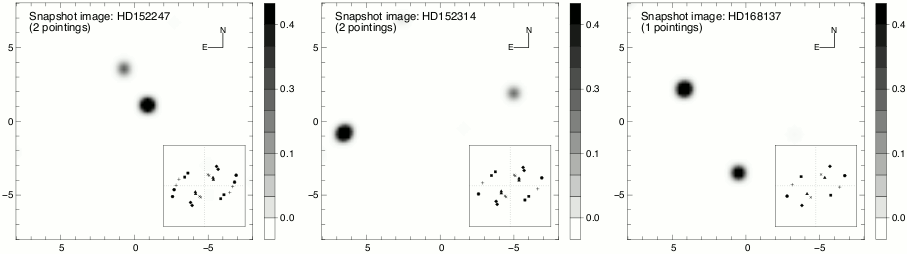 |
The Tarantula Massive Binary Monitoring
Taking the characterization of massive binaries in the 30
Doradus region to the next level, we are combining an
18-month long VLT/FLAMES and XSHOOTER spectroscopic
monitoring of 95 massive binaries with 10 years of OGLE. OUr
aim is to characterize the massive binary propulation
discover by the VLT-FLAMES Tarantula Survey in order
to test the theories of massive star evolution, including
the physics of binary interaction through tides and
mass transfer.
The
VLT-Flames Tarentula survey
The 30 Dor region in the Large Magellanic Cloud is the
nesting place of thousands of massive stars. It is the
perfect laboratory to put on the testbed our understanding
of massive star evolution and, more specifically, of key
parameters such a rotation and multiplicity. In this
context, an international consortium led by Chris Evans from
Edinburgh has teamed up to obtained multi-epoch spectroscopy
of 1000 massive stars using the Flames instrument from the
ESO Paranal observatory. While many projects are linked to
this observing campaign, the specific role of Amsterdam is
to quantitatively analyse the hundreds of O stars observed,
to accurately derive their stellar parameter and their
chemical composition. Find out about the project status and
our first results on the project
homepage...
The massive star binary fraction in young open clusters
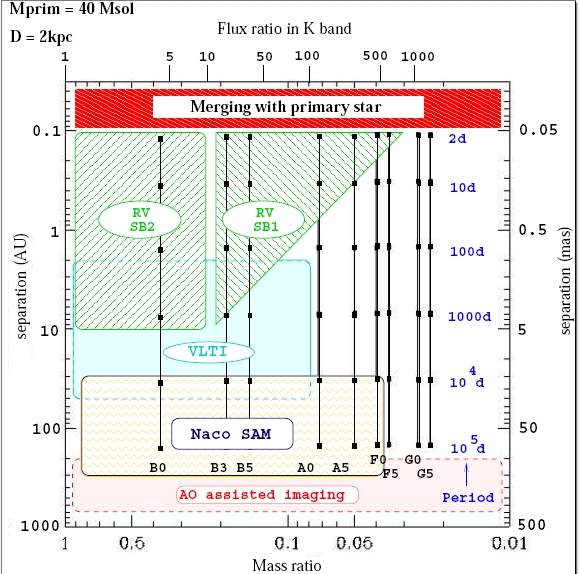 Typical parameter space for massive binaries. Relevant VLT instrumentation has been overlaid. Read more here... |
One of the most striking properties of the massive O stars is their large degree of multiplicity. Most of them are indeed forming a close pair with another massive OB star, revolving around their common mass centre in time scales of days to (tens of) years. While this fact is widely accepted, the exact binary fraction i.e., the fraction of massive stars having a close-by companion, is not accurately known, neither is the distribution of their orbital parameters and whether these properties are universal or are depending on, e.g., the environment of the star. We are thus engaged in a longstanding effort to detect and characterize the massive binary population in young open clusters. Check out our most recent publications on the topics here... |
A MAD view of Trumpler 14
| Two-color NIR image (H and Ks band) of Trumpler 14, one of the young open clusters of the Carina nebula region and a nest for a dozen massive stars. Among them, HD 93129A, the brightest star in the field, is one of the very rare O2 supergiants. A million time brighter than the Sun, its mass is probably about 80 solar masses and its temperature close to 45 000~K. The full mosaic image, covering a field of view of 2' in diameter, has been obtained by MAD, the ESO Multi-conjugate Adaptive optics (AO) Demonstrator. By contrast with current AO facilities that use only one star, MAD relies on three natural guide stars to correct for atmosphere turbulence over a wider field of view. This image has an average quality (FWHM) of 0.2" while the actual seeing in K band was about 0.90". This image is the largest AO-corrected mosaic ever acquired. Read more here ... | 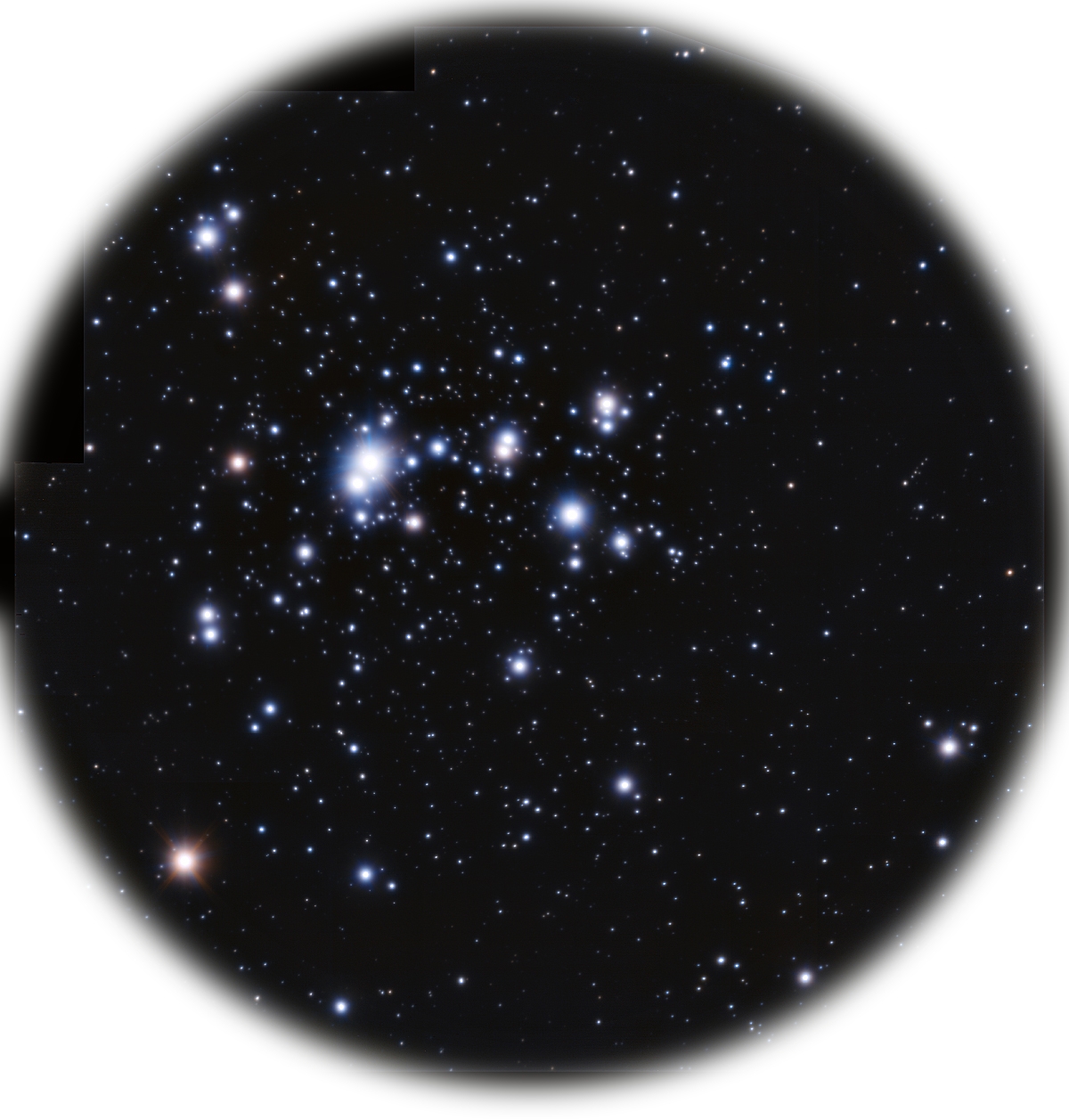 |
Modelling the Earth telluric
spectrum
Ground-based spectroscopic observations in the red and in
the infrared (IR) are inevitably affected by the atmosphere
layer that the light has to cross to reach the observer. The
scientific spectrum of a particular target of interest is
thus polluted by the many telluric lines whose strength
depends of the properties of the atmosphere at the time of
the observations. Traditionally, this problem is
circumvented by the observation of a telluric standard star
obtained as close in time and direction as possible to the
main target, and used to callibrate the atmospheric
signature. Such observations are a necessary 'waste' of time
and, in the current era of large ground-based telescopes, is
particularly costly. With this project, we aim at providing
an accurate tool to model the telluric spectra to optimize
the preparation, observation and analysis phases for red and
IR spectroscopy. Read more in the proceedings
of the IAU...
The Liège Orbital Solution Package
LOSP is a FORTRAN77 numerical package that allows its user
to compute the orbit of spectroscopic binaries. The
algorithm has mostly been developed at the Liège University
during my PhD. The code and the package has now been made
sufficiently robust and user friendly to be released to the
public. More details and package download on the LOSP page...