


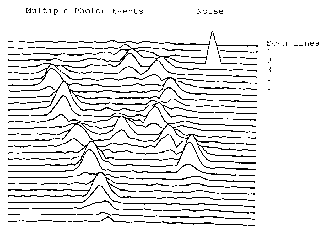
As a line is scanned, a gaussian shaped pulse is produced. As successive lines are scanned, additional pulses, corresponding to slices of the event, increase in peak amplitude until a maximum is reached. The pulse amplitude then decreases. This video signal is amplified and presented to the VPU which takes the incoming video lines and produces two signals needed to analyze the waveform, Peak Signal and Extent Signal. The Peak Signal corresponds to the point of maximum amplitude of an event on a single scan line or slice. The Extent Signal is used to determine the time or extent of the event during a single line.
A true photon event is present on several successive lines. Analysis of these events characterized by the peak and extent signals on successive lines is the task of the VPU. By using delay lines and shift registers, each event is examined in a 4 9 pixel area by real time analysis so that the same event on successive lines can be analyzed. The z-dimension event center is tagged in the x and y direction. The Pattern Recognition Logic analyzes the event's shape to determine true photon events and reject other noise and ion events.
Figure 4.18: Schematic Drawing of a Typical Raster Scan Output of the Detectors.
Generated with CERN WebMaker