


The photoelectrons generated at the first stage are accelerated by a 12 kilovolt potential and impinge on a P11 phosphor layer coupled by a 4 micron thick mica membrane to the second photocathode. This amplification process is repeated in the second and third stages to achieve an overall photon gain of 1.3 105. Focusing of the intensifier electrons is accomplished with a carefully shaped permanent magnet assembly and a trimcoil is added around the third stage for fine adjustments.
The limiting spatial resolution of the intensifier is 35 line-pairs per millimeter. The dark current at an ambient temperature of 17xfb C is less than 10 counts cm-2 s-1 (10-4 counts pixel-1 s-1 in the normal mode). Both of these characteristics are essentially limited by the first stage of the intensifier tube.
A lens assembly consisting of 9 components in a double Gaussian design is used to transfer the image from the output phosphor of the intensifier to the fiber-optic faceplate of the TV camera. It is designed to operate at f/2.7 with a slight magnification (1.15) to compensate for the demagnification of the image intensifier. The 80% energy width for point object images varies between 22 and 35 microns over the whole of the useful area and the light transmission is more than 60%.
During operation each diode is reverse biased. Incoming photoelectrons generate electron-hole pairs which discharge the diodes. An amplified charge pattern corresponding to the image is then stored in the diodes. The charge flowing in the target lead, when the scanning beam recharges the diodes, is the signal current. The target gain is about 2500 and the modulation transfer function is 50% at 8 line-pairs per millimeter. The video signal coming from the TV tube is amplified by the preamplifier and then transmitted to the Video Processing Unit (VPU).
Generated with CERN WebMaker
Figure 4.17: Physical Layour of the Imaging Photon Counting Detectors
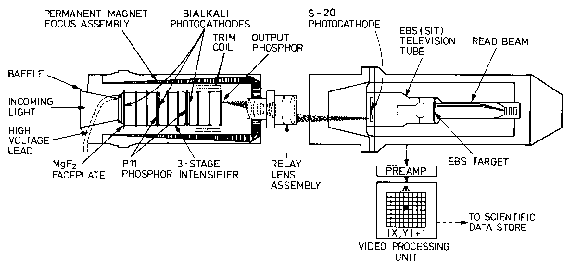
Image Intensifier and Coupling Lens
The intensifier is an EMI 9614 three stage tube magnetically focused by means of a permanent magnet. The first-stage photocathode (like the following two) is a hot bialkali for the highest quantum efficiency in the UV-blue region and the lowest dark-count rate at 17xfb C. It has a useful diameter of 40mm and is deposited on a MgF2 input window. TV Tube
The camera tube is a Westinghouse WX32719 low-light TV tube. This is a high-sensitivity, high resolution EBS tube (Santilli and Conger in Photo-Electronic Devices, AEEP, ed. L. Marton, 33A, 1972) with a 25 millimeters square diode array target, magnetic focus and deflection coils and an electrostatically focused image section with a 40 millimeter diameter useful photocathode area. The S-20 photocathode is evaporated onto the concave inner surface of the input fiber-optic faceplate. The emitted photoelectrons are accelerated by a potential of up to 12 kilovolts and focused onto the target which is an N-type silicon wafer with diffused P-type regions arranged in an hexagonally-packed diode array.