


Because of the large amount of time necessary to obtain external flat fields for the FOC, these two UV flat fields (one for F/96 and one for F/48) are currently the only UV flat fields for the FOC. We obtained another UV flat field at about 2200Å during 1994, although at the time of writing this has not been analyzed.
In all images, regardless of format, a number of pixels at the beginning of the scan line (i.e., starting at S=1) are corrupted by defects in the beginning of the scanning sawtooth waveform. The number of pixels corrupted depends on the detector and format. Generally it is about 5% of the scan line for the F/96 relay and relatively independent of format, whereas for the F/48 relay it gets progressively worse with smaller formats (for the 128 128 format it is as much as 25% of the scan line). The faint horizontal stripes seen at small L values are due to a ripple instability of the coil drivers at the beginning of a frame.
The narrow line running from the bottom left corner to the upper right corner is due to the read beam not being completely blanked when it is forced to fly back to S=0, L=0 at the end of the frame. This feature is more noticeable with the smaller formats. The narrow horizontal features at the right edge, especially at L=256, 512, 768, are due to noise glitches on the scan coil driver caused by changes in the most significant bits of the line counter. For both relays, the center 512 512 is seen outlined in larger formats. This effect is due to a burn-in of that heavily used format in the camera target so that a charge discontinuity at the edges of the format has appeared. The edges of a square baffle located just in front of the detectors limit the extended field of the F/96 relay at the upper and lower left corners, the extended image field of the F/48 relay on the upper left corner. The broad vertical bands (bright and dark) seen near the beginning of the scan line arise from ripples at the beginning of the scanning sawtooth waveform. The bands occur as a result of the varying pixel size which is a consequence of the varying scan rate at the beginning of the scan. If they were only an effect of geometric distortion, a proper geometric correction would remove this effect; however, the new geometric correction files for F/96 do take scan line variations into account, and do not seem to remove the effect entirely. It will be possible to remove residual effects with format dependent flat fields, but at the moment they are not applied by the normal pipeline calibration (the normal pipeline calibration of the images always uses the appropriate section of a full format flat field to flatten images obtained in all formats).
The remaining features fall into two categories, large scale and small scale features. The large scale variations are due either to vignetting (significant only for the F/48 relay) or detector response. The expected vignetting for the full the F/48 full field format is shown in Figure a as a contour plot. Contours are shown as percentage transmission. The expected vignetting has not been included in the flat field for the F/48 relay shown in Figure A12.1 so that features closer to the edge can be better seen. Figure b shows the vignetting function along the long slit.
Figure 6.10: a. Contour Plot of the Vignetting Function for the F/48 Relay Across the Entire Photocathode, with the location of the primary 512 512 imaging format shown (dotted line). b. Plot of the vignetting function along the spectrographic slit.
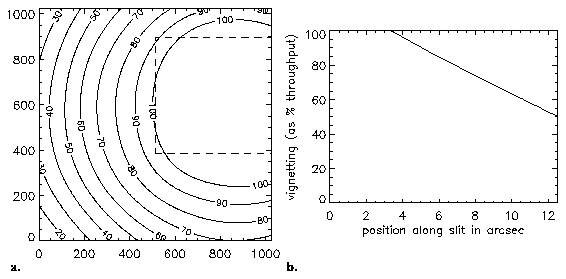
Figure 6.11: a. Contour Plot of the Smoothed Flat Field for the F/48 Relay, including the effects of vignetting. b. Contour plot of the smoothed flat field for the F/96 relay.
Contour plots of smoothed flat fields, including the effects of vignetting for the F/48 relay, are shown in Figure . A gaussian with a FWHM of 9 pixels was used to smooth the image and the result was normalized to 100 at the center. Figure 6.12 shows a plot of row 300 of a UV flat field for the F/48 relay and the F/96 relay respectively to give a better idea of the size of the flat field variations.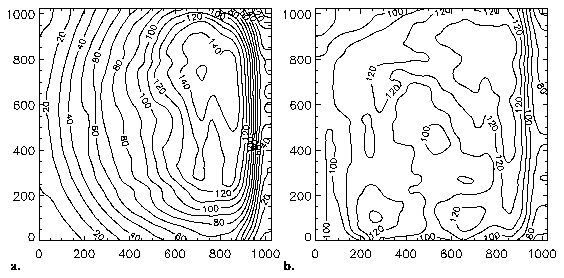
Figure 6.12: Plots Across Row 300 of the UV Flat Field for the F/48 relay (a) and the F/96 relay (b). The effect of vignetting has not been included in plot (a).
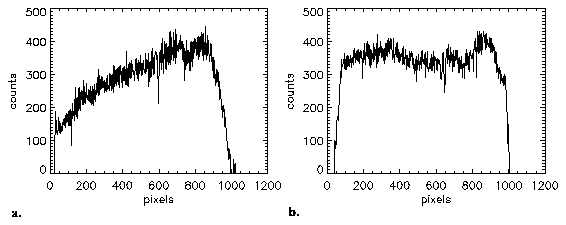
Figure 6.13: Contour Plot of the Ratio Between External UV Flat Field and Internal LED Flat Field for the F/48 Relay (a) and the F/96 Relay (b) Based on Pre-COSTAR Data. The expected effects of vignetting on the ratio for the F/48 relay are not included. The center of each plot has been normalized to 1 with the contours at intervals of 2.5%.
All previous indications are that the relative variations in large scale response as a function of wavelength between 1300 and 6000Å are weak; generally speaking, the large scale response does not change more than 10% at all pixels except at the edges and corner of the full format. Figure 6.13 shows contour plots of the ratio of the Orion Nebula derived flat fields to those obtained from the onboard LEDs for the F/48 and the F/96 relays respectively.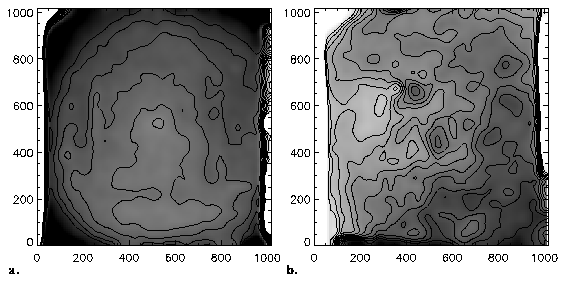
Beyond 6000Å, the flat fields begin to change significantly, generally with poorer relative sensitivity towards the corners. Although the changes in the large scale response with wavelength are relatively minor, the changes in the fine scale features is more pronounced. Scratches and other small scale defects deepen in the far UV; for the F/96, some scratches exhibit as much as a 30% decline in sensitivity in the far UV. Another source of fine scale nonuniformity is the presence of patterns--unfortunately not fixed. Although not always easily seen in low count extended areas or flat fields, there are two different patterns always present. The more noticeable one is an approximately sinusoidal pattern with the peaks and troughs oriented at an approximately 45 degree position angle and a period of 3.35 pixels for the F/96 relay. It is believed to originate from a moiré effect between a TV tube grid and the diode array on the target. The RMS amplitude of this pattern is approximately 5% for the F/96 relay and 2.5% for the F/48 relay (the peak deviations from a flat response due to this pattern are at least twice these values). This pattern becomes intensified when count rates are in the nonlinear regime and thus is much more easily seen. In fact, it is a quick way of recognizing serious nonlinearity in an image. The pattern noise disappears at very low count rates.
A second pattern arises from some form of interference with an FOC digital timing waveform that has a 4 pixel period. It shows up as vertically striped patterns on the flat fields. Although very coherent in nature with regard to orientation and frequency, the details of the modulation do not appear to remain constant from image to image. The RMS amplitude of this pattern is approximately 2.5% for both relays.
There also appears to be an intrinsic granularity in the fine scale response, i.e., effectively random pixel-to-pixel variations in response which has not yet been well characterized.
Some comments on flat field calibration are in order, especially with regard to the routine pipeline calibration. Small drifts in distortion of the order of a pixel result in misregistration of fine scale features such as scratches between the flat field and the science image. Flat fielding the data in this case actually worsens the effects of the fine scale features by correcting the wrong pixels. For this reason and because FOC flat fields are of relatively low signal to noise (typically 300-500 counts per pixel), the flat fields used in RSDP are heavily smoothed to eliminate most of the fine scale features. As a consequence, they are not corrected for in the calibrated outputs of RSDP.
Unsmoothed flat fields are available from STEIS, and by using them, it is often possible to improve the flat fielding by the appropriate registration of the flat field to the science image. But this requires scientific judgment and must be applied on a case-by-case basis.
One final effect should be mentioned. Although it is not a flat field issue, it appears to many at first glance to be one, and so it will be explained here. Many observers see a fringe or fingerprint type of pattern in the background of their calibrated images where the fringes are of relatively low spatial frequency--usually of periods of 20 or more pixels. It is a result of the geometric correction applied to the data. It does not appear in the raw data. What is being seen is not alternating areas of darker and brighter background, but rather, alternating areas of higher and lower variance in the poissonian noise of the background. This effect arises from the resampling algorithm used in the geometric correction--essentially what one is seeing is the effect of the pixels in the output, geometrically corrected image drifting in and out of phase with the corresponding pixels in the input, distorted image. Those pixels mapping directly to the center of a pixel in the input image result in little or no effective smoothing, while those which map to a point in between pixels in the input image will be an average of the input pixels and thus have smaller variance in the noise. A small amount of further smoothing to the geometrically corrected image will virtually eliminate the effect. The pattern is identical in all images as long as they use the same geometric correction file.
The achievable relative photometric accuracy depends on many factors, of course, and no simple rule of thumb will apply to all analysis. In many cases the accuracy depends on the amount of work an observer is willing to do to calibrate his data. For RSDP calibrated files, one should not expect the large scale accuracy to be better than 3-5% over the central region of the format, and should expect errors as large as 10% closer to the edges (much higher very close to the edges). Fine scale features can introduce large pixel-to-pixel errors (i.e., scratches and reseau marks). Scratches and blemishes can be dealt with by careful flat fielding. It is sometimes possible to remove the pattern noise with special techniques. Most important is to avoid placing targets on or near areas with serious photometric problems if possible. That is, keep targets of interest way from the edges of the format, burn-in regions, A/D glitches and known blemishes if more accurate photometry is desired.
Generated with CERN WebMaker