


After a long period of inactivity, the F/48 was switched on again in November 1994, for the first time after the COSTAR deployment. Images and spectra of an extended target were successfully obtained, and showed a completely different behavior from the earlier tests.
A direct comparison of all nine spectra taken during the November test was made to determine the characteristics of the background as a function of time after switch-on. The high background was still localized in the central area of the image (flare), and in the upper arc across the top of the images. The locations of these features can be seen in Figure , where all the images are displayed with the same intensity contrast to allow direct visual comparison. But, it was clear from a cursory comparison that instead of increasing in intensity over time, the flare actually tended to subside over time since switch-on.
Figure 6.17: Mosaic of F/48 Images Taken Ordered by Time After Switch-on during the November 1994 Test. Earliest image is on the left. All are displayed with respect to the same count rate scale, to show how the flare actually tended to subside over time since switch-on. The regions of the flare and arc are marked in the center image.
This finding was confirmed in the course of three additional successful turn-ons, on March 5 on March 30, and on April 18, 1995. In all cases the background decreased significantly as a function of time, to reach a value lower than 10-2 cts/sec/pix after approximately 250 minutes after switch-on. In Figure 6.17, the background is measured in three sample regions (flare, arc, background) in the images taken during the final run, and is plotted as a function of time. This test had a duration of approximately 600 minutes, compared to only 300 minutes for the first two. Although we notice a similarly decreasing trend, the latest test shows somewhat lower background values. Furthermore, the measurements taken in the final 300 minutes show that the intensity of the flare and arc tend to decrease with time after turn-on. The background measured is still higher than nominal in the regions of the flare and arc (see "Geometric Distortion and Stability" on page 87 for comparison), but the camera is demonstrated to be operational and quite stable, within the background limits mentioned.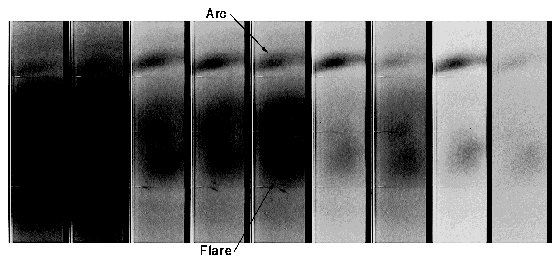
Figure 6.18: F/48 Camera Background Measured in Three Areas (A: arc - solid line; B: flare - dotted line; C: background -dashed line) During the Latest Test, and Plotted as a Function of Time After Camera Switch-on. The relay showed this same basic behavior during each observation run.
More tests are planned in the next months, to establish if any improvement in the background values occurs with time. However, the results so far have been encouraging and the decision has been taken to make the F/48 camera available to the users in Cycle 6, limited to LONG SLIT SPECTROSCOPY ONLY. The long slit facility is presently unique on board the HST. After the refurbishment mission planned for 1997, STIS will be able to replicate, more efficiently, all the features of the F/48 long slit spectroscopy (see STIS Mini-Handbook for additional details). However, given the current performances of the F/48 camera, it was felt advisable to provide the users with the choice to take advantage of these presently unique capabilities. Since some limited risk is still associated to the success of the future F/48 observations, the users who will choose to apply for F/48 time will be allocated F/48 time only, with no possibility to switch to a different instrument in case of failure.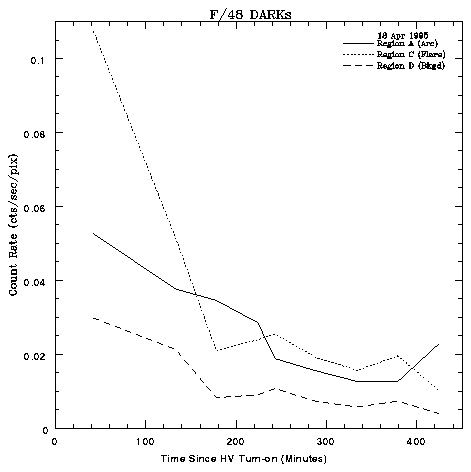
Generated with CERN WebMaker