


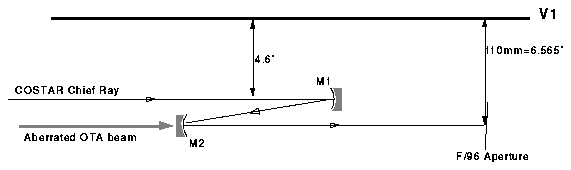
COSTAR replaced the High Speed Photometer in the Axial bay of HST, in the V2, +V3 quadrant (see Figure 4.3). It is a "passive" instrument, in that it has no detector of its own, its sole purpose being to deploy a set of mirrors in front of the other Axial Scientific Instruments (ASI). These mirrors, and their associated mounts and arms, serve only to block the aberrated OTA beam from entering the ASI entrance apertures and to correct the spherical aberration of a different part of the OTA field of view before re-directing the corrected beam into the ASIs. A schematic diagram of the COSTAR optics in front of the F/96 relay is shown in Figure 2.1
. There is a separate set of mirrors that corrects the F/48 channel, mounted on the same arms as those for the F/96 channel.Before COSTAR, the aberrated F/24 OTA beam at 6.565 arcminutes from the V1 axis formed an image at the FOC focal plane aperture 110 mm from the V1 axis. After the deployment of COSTAR, the M2 mirror and its mounting arm blocks this light from entering the aperture. The beam that would have formed an image 4.658 arcminutes from the V1 axis is re-directed by the spherical M1 mirror to form an image of the OTA exit pupil on the M2 mirror. This mirror becomes the exit pupil of the OTA+COSTAR optical system, and the anamorphic aspheroidal figure fulfills three functions:
The correction of the spherical aberration of the OTA by COSTAR does introduce a small number of side-effects that were not present in the original design of HST+FOC. Firstly, the focal plane tilt of the OTA at the FOC entrance apertures cannot be duplicated by the 2-mirror COSTAR system. The tangential and sagittal image planes produced by COSTAR are tilted with respect to those in the OTA, and tilted appreciably with respect to each other. This means that perfect astigmatism correction can only be achieved at one field point. Similarly, the mean focal surface produced by COSTAR is tilted with respect to the mean focal surface produced by the OTA, so that there is a field-dependent focus variation. These effects are described more fully in Section .
Secondly, the HST+COSTAR exit pupil is now only 530mm from the FOC entrance apertures (compared to 7m for the uncorrected OTA). This causes unavoidable vignetting in the F/48 camera for field positions more than about 12 arcseconds away from the optimally-corrected field point. The effects of this vignetting are discussed in Sections 4.2 and 6.9. The F/96 channel does not suffer from vignetting. For this reason, it was decided to make the F/96 channel the "preferred" channel of the FOC, and attempt to optimize the image quality of this channel.
Figure 2.2: A Schematic View of COSTAR, after deployment, showing the FOC light paths. For clarity, the FOS and GHRS M2 arms are omitted.
The M2 mirrors for both of the new channels are also on a single arm mounting, but there is no tip/tilt capability. Both arms are connected to the Deployable Optical Bench (DOB), which can be commanded to move over a 16mm range parallel to the V1 direction. This was used to focus the F/96 channel during SMOV. Again, it is anticipated that the focus position of the F/48 channel relative to that of the F/96 channel was set to an accuracy of 0.1mm or less during ground alignment.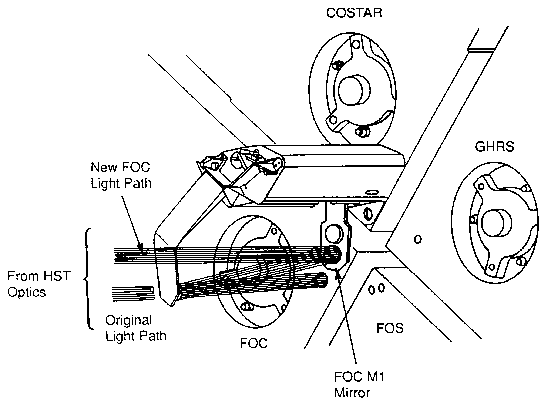
Generated with CERN WebMaker