


where n is now the chosen number of normal (z=1) or zoomed (z=2) pixels in the required resolution element and IS(l) is the specific intensity of the extended source in photons cm-2sec-1sr-1Å-1. Equations (3) and (5) for RB need not be modified. Conversion of other specific intensity units into photons cm-2sec-1sr-1 Å-1 can be executed via the relations in Table 7.3.
From Figure 4.9, you find that at l=1216Å, the F120M filter has T=0.1 and from Table 6.3 you deduce that Q(1216Å)=0.006. Then, since in this case the Jovian emission line of width 1Å is much narrower than the instrumental bandpass of 86Å, eq. (9)Table 7.3:
Suppose, for example, you want to observe a Lyman a aurora above the limb of Jupiter of intensity 20 kiloRayleighs with a spatial resolution of 0.28 arcseconds with a S/N = 10 with the F/96 relay. You will be using 400 F/96 pixels for this purpose. You should use the F120M filter because it has the highest transmission at Lyman a and the lowest transmission at the longer wavelengths where the disk Rayleigh scattering spectrum may overwhelm any far UV auroral features.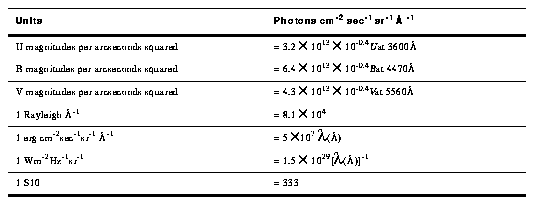
Relations
The background rate RB will be dominated by the detector background and the geocoronal Lymana airglow if the observation is carried out at night. From the curve marked the F/96, 1216Å in Figure 7.1 for a typical observing configuration of 150xfb local solar zenith angle, you obtain 2.2 10-3 counts sec-1 pixel-1 looking towards the zenith. This implies that, for Bp= 7 10-4 counts sec-1 pixel-1, you have:
This means that S/N=10 for this Jovian aurora and resolution can be reached in:
Observations at higher spatial resolution would require correspondingly longer exposure times.
If this same aurora is to be observed against a planetary disk background of Lyman a emission of 15 kilorayleighs with the same accuracy, the relevant background rate becomes:
so that:
In this case, however, you might be looking onto the visible disk of the planet and the visible leak will dominate the count rate. To estimate the visible leak contribution notice that at @5000Å, the F120M filter has a residual transmission of 10-4 and assume the Jovian spectrum to be solar with an intensity of @2106 Rayleighs Å-1 at 5000Å. Thus, you can approximate the effect by spreading this intensity over @1500Å where Q(l)@0.03. Then, with these assumptions:
A solution to this problem would be to insert another filter into the beam to suppress the visible contamination. A good choice would be F140W for which T(1216Å) = 0.05 and T(5000Å) = 3 10-4 and:
Obviously, this hypothetical program cannot be accomplished with the FOC. To reduce the exposure time to physically realistic levels one needs to, say, reduce the required accuracy and/or spatial resolution. For example, halving both the accuracy and the resolution yields a more acceptable exposure time of 1.6 hours.
Finally, suppose you wish to image an extended object (a planetary nebula, for example) with the F/96 relay at the highest possible resolution in the zoomed configuration for the biggest possible field of view. Suppose the object exhibits a line spectrum with a surface brightness at Hb of 5 10-13 ergs cm-2sec-1 arcsec-2 and you wish to use the F486N interference filter to isolate the line to an accuracy of 10%. From the data shown in Figures 12 and 29 you find that at 4861Å, T = 0.6, and Q = 0.026. From the conversion relations, you note that Is(4861) = 5 10-13 4.25 1010 5 107 4861 = 5.16 109 photons cm-2 sec-1 sr-1. Thus, eq. (9) becomes for n=1, z=2:
From the data shown in Figure 7.2 and a zodiacal light brightness of 90 S10 and Bp = 7 10-4 counts s-1 per normal pixel, eq. (5) becomes:
because T(lo) = 0.63 and Dl = 34Å for the F486N filter from the data in Table 4.1. In consequence, finally:
Generated with CERN WebMaker