


The filter wheel system of the F/96 camera allows, in principle, up to 124 or 20,736 and up to 82 or 64 different combinations of optical elements for the F/48 relay. Clearly, only a fraction of these will find a useful astronomical application. Observing configurations requiring more than one filter on the same wheel are not possible, of course. Filter positions on the wheels were carefully selected in order to minimize this possibility. The time required to change some filter combinations may reach 3 minutes. This implies a considerable expense in overhead time for programs requiring extensive cycling between filters.
Table 4.1: F/96 Optical Element Characteristics Ordered by Peak Wavelength

Table 4.2: F/48 Optical Element Characteristics Ordered by Peak Wavelength.
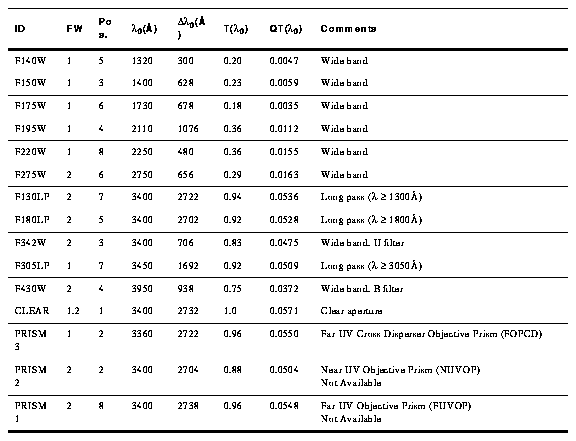
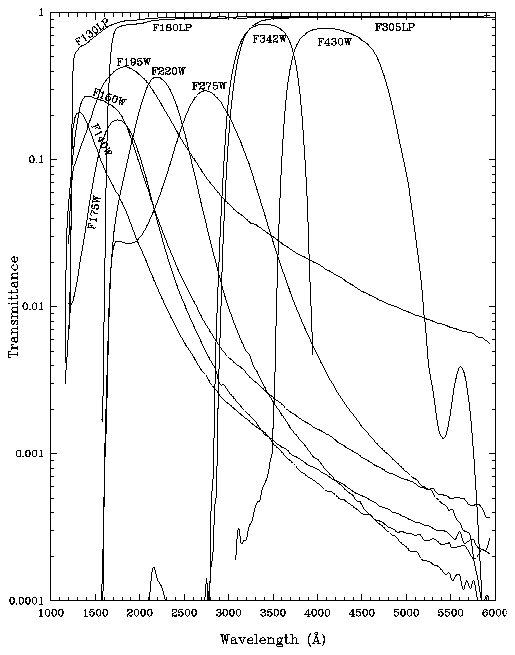
Figure 4.7: Transmittance of the Long Pass and Wide Band Filters on the Filter Wheels of the F/96 Relay as a Function of Wavelength.
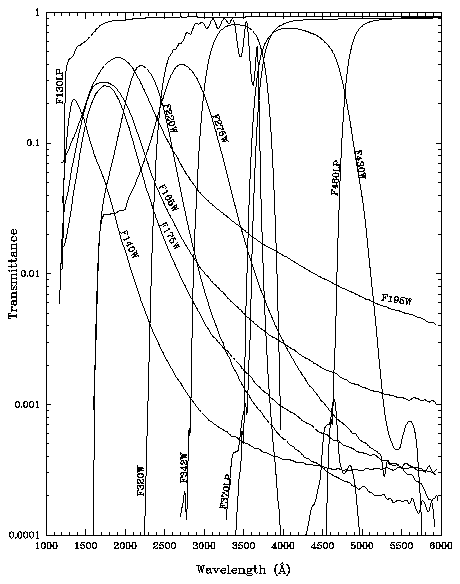
Figure 4.8: Transmittance of the Visible Medium and Narrow Band Filters in the Filter Wheels of the F/96 Relay as a Function of Wavelength.
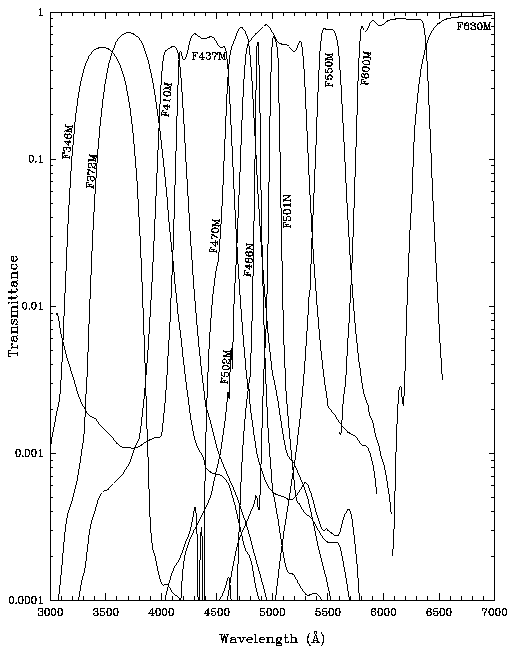
Figure 4.9: Transmittance of the UV Medium Band Filters on the Filter Wheels of the F/96 Relay as a Function of Wavelength. The F120M and F130M Filter Transmission Curves Remain Essentially Flat at 10-4 beyond @ 2500Å.
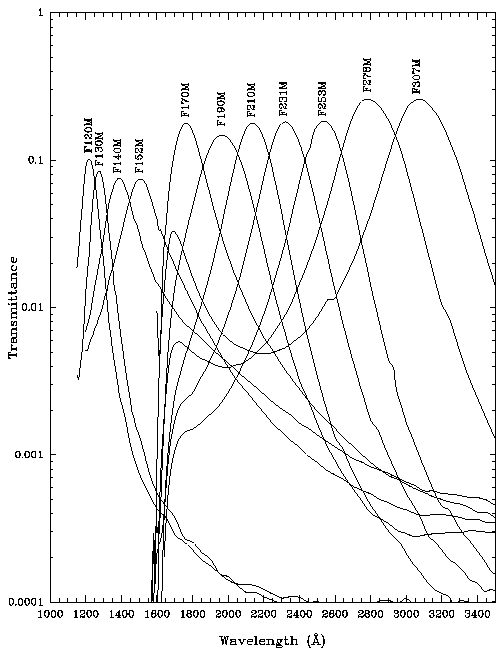
Figure 4.10: Transmittance of the Neutral Density Filters on the Filter Wheels of the F/96 Relay as a Function of Wavelength.
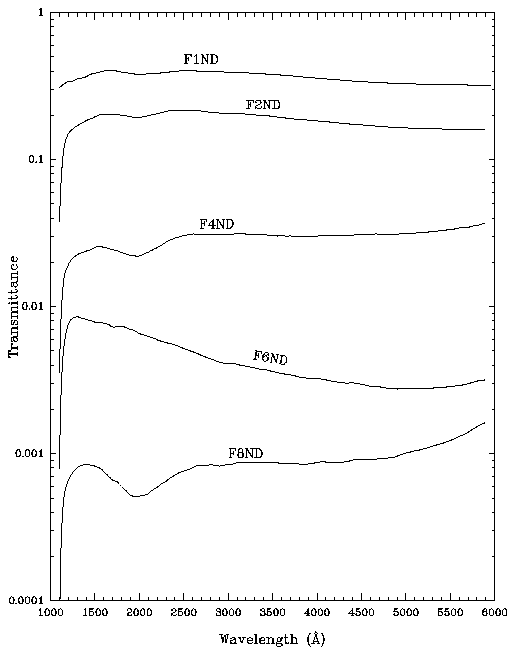
Figure 4.11: Transmittance of all Filter Wheels of the F/48 Relay as a Function of Wavelength.
Bandpass and Neutral Density Filters
In general, the long pass filters are Schott colored glass combined with a low pass filter, the wide band filters are metallic UV filters, the medium band filters are multi-dielectric multi-element with ZnS-Th F4 layers, and the interference filters are multi-dielectric multi-element with ZnS chiolithe layers. The measured transmission versus wavelength curves for all filters and attenuators for the F/96 relay and the F/48 relay are shown in Figures 4.7 through 4.11.
In order to suppress ghost images, the external faces of all mono-element filters are parallel to within 5 arcseconds or better. For multi-element filters the tolerance is 1 arcminute. The cemented elements have a wedge angle of 1xfb or less. In order to minimize losses in the modulation transfer function, the external faces are flat to l/5 peak to peak at 6300Å and the internal faces in the multi-element filters are flat to l/2 peak to peak. The refractive index is homogeneous to a level of Dn< 2 10-5 to be consistent with the l/5 flatness constraint. These conditions have been complemented by the introduction of appropriate tilt angles of the different filter wheels themselves. Transmission non-uniformities are held to within xb1 5% over the whole surface.
The essential features of the FOC objective prism facility are listed in Table 4.3 Table 4.3: FOC Objective Prism Characteristics
A calibration program has been recently carried out to verify that the neutral density filters have transmission factors that match their ground-based measurements. The preliminary results indicated that the F1ND (1 magnitude) filter behaves as expected. The F2ND and F4ND filters appear to have 10% and 20% lower throughput than expected. The data quality for the F6ND and F8ND filters is not very good but suggests that their throughputs may be low by 20-40%. These numbers should be taken with caution since they have been measured at only a couple wavelengths, and are extremely difficult to determine accurately, particularly for the larger neutral density values. Further data analysis is planned to try to clarify these results.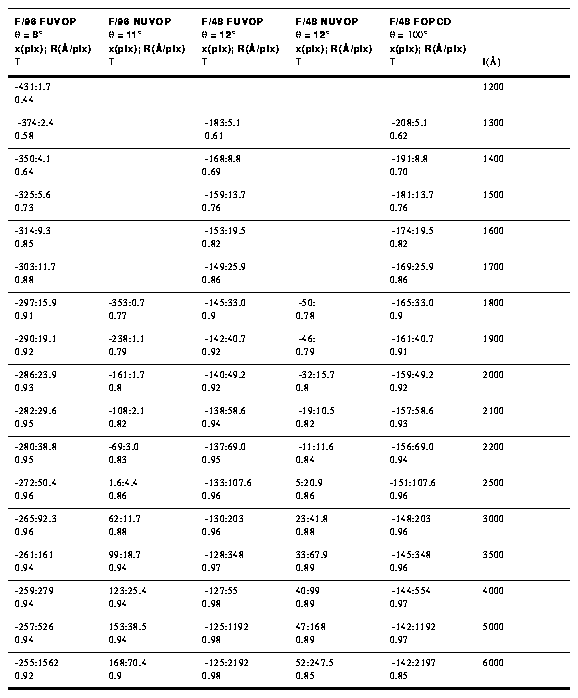
Objective Prisms
The objective prisms consist of either a single 30 millimeter diameter, 3 millimeter thick wedged crystal of MgF2 (the FUVOP and FOPCD, called PRISM 1 and PRISM 3 in the Instructions) or a combination of two wedged crystals of MgF2 and SiO2 glued together (the NUVOP called PRISM 2 in the Instructions). The former operates down to 1150Å with a wavelength resolution l/Dl@50 at 1500Å while the latter has a dispersion l/Dl@ 100 at 2500Å but transmits only above @ 1600Å. All of the prisms disperse in a direction oriented roughly anti-parallel to the increasing line number (L) direction except FOPCD on FW # 1 of the F/48 camera that, instead, disperses in a direction roughly perpendicular to L or about 90xfb to the others. This last one is meant as a cross disperser (CD) for the long slit spectrograph (see Section 4.15). The MgF2 prisms (FUVOP and FOPCD) on the F/48 relay (Prisms 1 and 3) are both preceded by a 3 mm. thick CaF2 window in order to reduce geocoronal Lyman alpha contamination. These prisms, therefore, have negligible transmissions below @ 1250 Å. emanating from the center C96 of the format and making an angle q with -L with q increasing clockwise from -L. The spectrum of an object located at C96 will lie along the line defined by
  . The position of any specific wavelength is defined then by giving the linear coordinate x in pixels from C96 on this line with negative values for positions above C96 (towards +L), positive below it (towards -L) consistent with the
  directions shown in Figure .
A blow-up of this spectrum extending from 1200 to 6000 Å as dispersed by the FUVOP is shown on the right hand side of this figure where the solid curve gives the position x along  of any wavelength for this case. The reciprocal of the slope of this curve yields the resolution R in Å/pixel given in the figure for several representative wavelengths. Values of the linear coordinate x(l), R(l), T(l) the transmission of the prism and the value of q for each prism is listed in Table as a function of wavelength. Please note that the angle q for the prisms of the F/96 relay increases clockwise from -L while it increases counterclockwise from -L for the prisms of the F/48 relay due to the different orientation of the F/48 format shown in Figure 4.5. The position of the entire dispersed FOV with respect to the undispersed FOV is also shown in Figure 4.12. The former is displaced upwards by 5.88 millimeters at the red limit at 6000Å at the upper edge and 9.96 millimeters at the far UV limit at 1200Å at the lower edge of the field.
Figure 4.12: Optical Layout of the Focal Plane of the F/96 Relay with the FUVOP Inserted in the Beam. The star is assumed to be located at C96 in the entrance aperture of Figure .
A composite image showing the central 256 512 pixels of the undispersed image of a star in the post-COSTAR F/96 256 1024 image and its associated Far-UV objective prism spectrum is shown in Figure 12.4 in Chapter 12. In this 256 1024 centered format, the star was placed well below the center of the format so that in the next image, the dispersed FUVOP spectrum is roughly centered. The two images were then co-added to produce Figure 12.4. It should also be apparent from an inspection of Figure 4.12 and Table 4.3 that careful consideration must be given to the positioning of the format and/or the target object in the format in order to ensure that the ensuing spectrum falls on the correct part of the frame. This is especially critical for the FUVOP's that have a large offset and a spectrum length which is a sizable fraction of a typical field of view. The simplest way to handle this problem is through judicious use of the POS TARG special requirement described in the Proposal Instructions. Suppose, for example, that one desires to place a particularly interesting feature in the spectrum of an object located at @ 1500 Å close to the center of the image for the F/96 relay listed in Table 5.1 using the FUVOP. According to the data given in Table and the situation illustrated in Figure 4.12, one would specify a POS TARG 0, -4.6 because 1500Å falls 325 pixels or 4.64 arcseconds from the undispersed position of the object in the positive Y(or L) direction specified in the Proposal Instructions.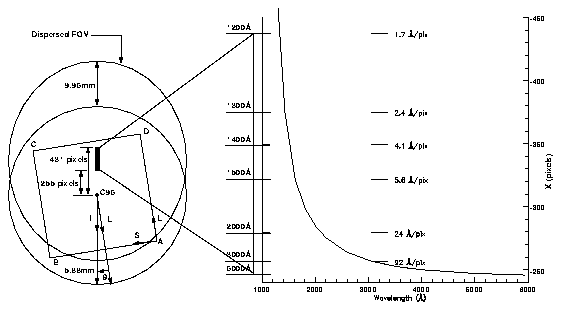
Polarizers
The FOC polarimeter consists of three MgF2 double Rochon prisms located on FW1 in the F/96 relay. Each prism consists of an optically contacted double Rochon prism combination acting as a three element birefringent beam splitter. The pass directions of the prisms are at 0xfb , 60xfb , and 120xfb , counterclockwise from the image X axis (-S direction) as projected onto the sky. A schematic drawing of the device is shown in Figure 4.13. These values are known to an accuracy of approximately 3xfb (see "Polarization" on page 123 for more details).
The optical axes of the outer components A and B are oriented perpendicular to the optical beam axis while the central component C has its optical axis parallel to the beam axis. The entrance face is at the base of the central prism. In this configuration, the ordinary ray is transmitted without deviation while the extraordinary rays are deviated by the interface between the outer and central prisms. Thus, three exit beams emerge from the polarizer. The orientation of polarization is parallel to the face of the octagon to within xb1 5 arcminutes and the external faces are parallel to within xb1 5 arcseconds. This insures that the wavefront distortion is less than l/10 at l 6328Å. The beam deviation d depends on the ordinary and extraordinary indices of refraction and the prism wedge angle. These parameters were chosen such that the angular separation of the beams will yield a central undeviated 11 arcseconds squared image without overlap of the two orthogonally polarized beams. Thus, d= 1.155xfb for l=1300Å and 1.165xfb for l=6328Å. In these conditions, the images on the focal plane of the new F/96 relay will be located as shown in Figure 4.14 for the three prisms.
Figure 4.13: Physical Layout of the FOC Polarizers (dimensions in millimeters).
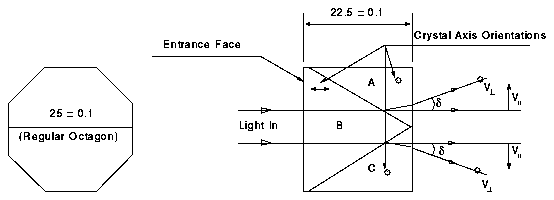
Figure 4.14: Image Configurations on the Focal Plane of the F/96 Relay for the Three Polarizers.
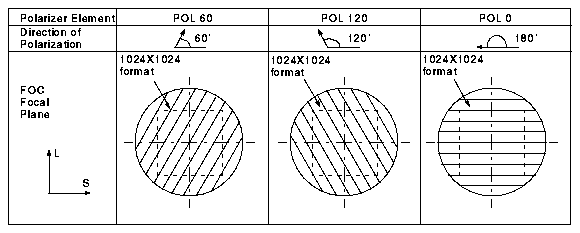
Figure 4.15: Major Principal Transmittance TMAJ and the Minor Principal Transmittance TMIN of the Three FOC Polarizers as a Function of Wavelength.
The major principal transmittance (TMAJ) of the undeviated beam through the three prisms and the minor principal transmittance (TMIN) of the normal nonpolarized light are given in Figure . Notice that one of the polarizers (POL60) does not transmit below @ 1800Å. There are limitations on the accuracy which is attainable with this facility, but current calibrations have attained accuracies for relative photometry of approximately 5% (1s), with more details available in Section . A major factor is that the three different polarizers have somewhat different throughputs, even longward of 3000 Angstroms. While the filter transmissions have been measured, filters do change with time, and color variations in the source will result in small differences in the actual throughput. In addition, the light reaches the polarizers only after reflection off the OTA, COSTAR and the FOC primary and secondary mirrors (but before the fold mirror). Each of these six reflections is at a non-zero angle of incidence, ranging from a few minutes of arc for the OTA primary to about 11.5xfb for the FOC secondary. Such reflections introduce a phase shift in incident polarized light and a slight instrumental polarization which Cycle 4 calibrations have determined to be less than 5% based on observations of unpolarized stars. The reflections off the COSTAR optics are at angles of incidence that are smaller than the angles for the FOC optics, resulting in performance comparable to the pre-COSTAR case. At the time of the writing, extensive calibrations are planned for Cycle 5 to better characterize the polarizers.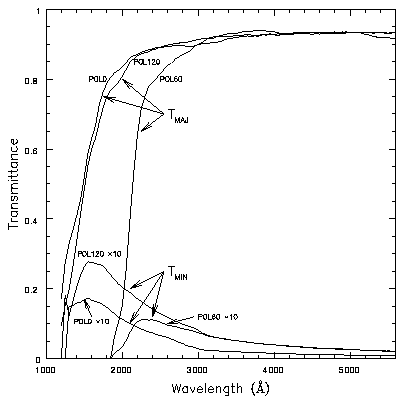
Generated with CERN WebMaker