


The spectrograph mirror and the grating are both made of Zerodur overcoated with Al + MgF2 with a reflection efficiency exceeding 0.7 beyond 1200Å. The grating is ruled with 150 grooves mm-1 and a blaze angle of 1.94xfb for maximum efficiency at 4500Å in first order. Its radius of curvature is 94cm and the angle of diffraction is 2.6xfb . This implies a linear dispersion at the photocathode of 71, 36, 24, and 18 Å mm-1 and, with a beam diameter of @ 20 mm., a theoretical resolving power of @ 3000, 6000, 9000 and 12000 for the four orders, respectively. The FOC spectrograph resolution, however, is limited, in practice, by the slit size and the OTA Point Spread Function (PSF) that correspond to @ two to three 24 micron pixels. Using the Rayleigh resolution criterion, the actual resolving power of the instrument is @ 1150 in all orders with a spectral resolution of 4, 2, 1.3, and 1Å for first, second, third, and fourth orders respectively. These values have been confirmed by ground-based calibration using line source stimulation.
Both the spectrograph mirror and the grating work with unit magnification. The convex mirror corrects the astigmatism introduced by the spectrograph's optical elements. The resulting image is nearly free of astigmatism and image tilt with respect to the photocathode plane. The fixed grating configuration of the long slit spectrograph implies that light from all orders falls simultaneously on the same area of the detector. Because of the limitations of the UV bandpass filters, any order may be contaminated with light from another, resulting in possible ambiguities in line identification and degradation of achievable signal to noise ratio (S/N) due to line or continuum overlap. This can be a serious problem in some applications, especially those involving objects with a bright visible spectrum where the spectrograph's overall quantum efficiency peaks.
Even in the most complicated situations, however, it is still possible, at least in principle, to separate the different orders by executing a number of exposures with judiciously chosen bandpass filters. Light from the first order, for example, can be unambiguously identified by means of the F305LP filter that completely blocks radiation below 3000Å. Since the filter transmissions are well known, shorter wavelength information can be recovered from a confused spectrum by appropriately subtracting the calibrated data. The F220W for the second order, F150W for the third and F140W for the fourth may be considered as the standard FOC spectrograph order sorting filters but others may be selected, at the discretion of the observer, instead of or in addition to these for more specialized applications. This procedure can always be used at the expense of increased observation time required by the multiple exposures and of degraded S/N due to the effectively increased background uncertainty. For extended sources larger than 1.6 arcsecond in size this is the only viable alternative.
For objects of limited spatial extent (including point sources), the four overlapping orders can be spatially separated by using the FOPCD objective prism as a cross disperser. The position of the four orders on the detector field of the F/48 relay in this case is shown in Figure 4.12. The prism dispersion direction PD is orthogonal to the grating dispersion direction GD and close to antiparallel to the increasing sample number direction S. The reader is referred to Figure 4.5 for a broader perspective of this viewing configuration. The largest achievable physical separation between orders is 7 pixels (0.20 arcseconds) between the first (I) and second (II), 15 pixels (0.42 arcseconds) between the second and third (III) and 36 pixels (1.01 arcseconds) between the third and fourth (IV) order. The background is significant only for wavelengths which are harmonics of bright geocoronal lines like OI, 1304Å. This option is very attractive because of its high efficiency due to the spectral multiplex gain of a factor of 4 and to the gain of a factor of 3 -- 5 resulting from the elimination of the bandpass filters. The CaF2 blocking filter on the FOPCD effectively removes the contaminating effect of the bright geocoronal line at Lyman a at 1216Å.
Figure 4.16: Optical layout of the F/48 focal plane in the spectrograph mode and the FOPCD in the beam. The coordinates are line numbers (L) as ordinates and sample numbers (S) as abscissas. Notice the different scales for S and L.
The open area to the right of the dotted line in the extended format of the F/48 relay in the spectrograph mode shown in Figure and Figure 12.3 of Chapter 12 is normally blanked out by selecting the 256z 1024 format. It should be kept in mind, however, that dispersed light from this part of the aperture is still falling on the photocathode and, if the field here is very bright (a bright galactic nucleus, or the central part of a nebula, for example), some contamination of the right edge of the slit spectrum due to scattering should be expected. 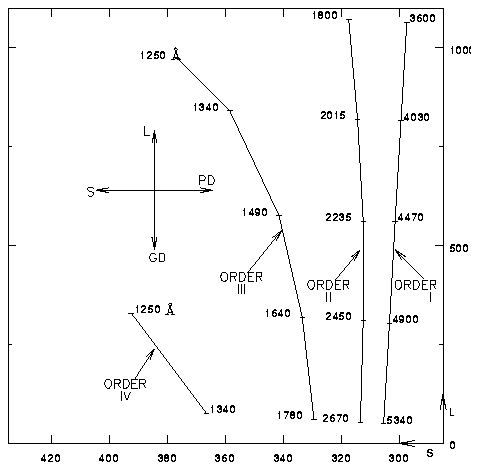
Generated with CERN WebMaker